
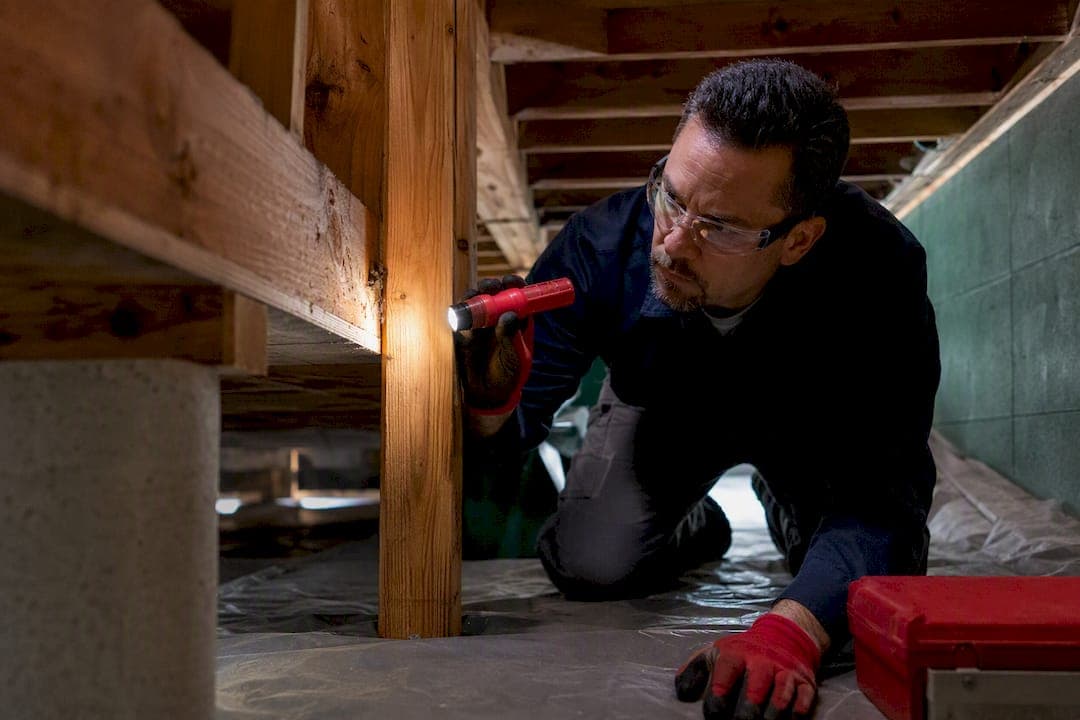
No, California law doesn't require a termite inspection for every home sale, but lenders and purchase contingencies usually make one unavoidable in practice. Buyers typically order the Wood Destroying Organism (WDO) report during escrow, though sellers sometimes pre-inspect to head off delays. Whoever orders it, the report must come from an inspector licensed by the Structural Pest Control Board, and it stays valid for two years.
TL;DR:
- Most California homes require a Wood Destroying Organism report during escrow, focusing on active infestations that may block lender funding.
- The inspection must be done by a licensed inspector within the first two weeks of escrow to allow time for negotiations and repairs.
- Section 1 findings of active infestation or damage are often mandatory for loan approval, while Section 2 issues are generally negotiable.
- The WDO report is valid for up to two years, so scheduling it close to escrow closure helps avoid report expiration.
- Buyers should prepare access, clear vegetation, and review prior reports to ensure an accurate inspection and reduce potential disputes.
Table of Contents
- Your Termite Inspection California Checklist for Escrow
- Understanding the WDO Report and What Sections 1 Through 3 Mean
- Are Termite Inspections Actually Required in California?
- What a Termite Inspection Costs and How Long It Takes
- How to Verify a Licensed California Termite Inspector
- Reading Your Report: Diagrams, Inaccessible Areas, and Recommendations
- What Happens Next if the Inspection Finds a Problem
- If Your Inspection Feels Wrong: Your Recourse in California
- Why Some Termite Damage Never Shows Up on the Report
- Resolving Disagreements Between Buyer, Seller, and Inspector
- Getting Your Home Ready for an Accurate Termite Inspection
- Termite Activity Changes by Season and Region Across California
- How Desantis Realty Group Keeps Inspections From Derailing Escrow
- Get Local Help Coordinating Your Inspection and Escrow
- Sources
Your Termite Inspection California Checklist for Escrow
Once you're in escrow, timing matters as much as the findings themselves. Schedule the inspection as close to closing as your contract allows, since anything discovered early can still change before you sign.
- Order it within the first two weeks of escrow so you have time to negotiate before contingency deadlines hit.
- Buyers typically pay for the inspection, but sellers often cover repairs, especially for active infestations.
- Watch for Section 1 findings (active infestation or damage) since some lenders won't fund a loan until those are cleared.
- Expect the on-site visit to take about an hour or more, depending on property size and conditions, with the written WDO report following within a few days.
If your purchase contract has an inspection contingency, mark that deadline on your calendar the day escrow opens. Missing it can waive your right to negotiate repairs later.
Understanding the WDO Report and What Sections 1 Through 3 Mean
The Wood Destroying Organism report is a standardized inspection document governed by the Structural Pest Control Board under California Business and Professions Code § 8516. That code sets the rules for what inspectors must document and how fast they must deliver findings, not just to the buyer, but to whoever ordered the report.
Every WDO report breaks findings into distinct categories:
- Section 1 covers active infestation or existing damage, and lenders frequently require this resolved before funding.
- Section 2 flags conditions likely to cause future infestation, like wood-to-soil contact or excess moisture. These are negotiable, not urgent.
- Section 3 and other notations cover further inspection recommendations or items outside the inspector's scope.
Inaccessible areas, locked rooms, tight crawlspaces, and similar spots must be listed separately since the inspector can only report on what was visible and reachable.
Are Termite Inspections Actually Required in California?
State law stays silent on mandating inspections for every transaction. What creates the practical requirement is your lender or your purchase contract. Most conventional and FHA loans on older properties won't close without a clean WDO report, and most standard California purchase agreements include an inspection contingency that gives buyers an exit ramp if problems surface.
Sellers still carry disclosure obligations separate from any inspection. If you've had a prior infestation or a past termite report on file, you generally must disclose it whether or not a new inspection happens. Withholding that history can create legal exposure well after closing.
Escrow officers and lenders don't treat every finding the same way, either. A Section 1 item often stops the loan process cold until it's resolved or bonded around. A Section 2 item usually gets negotiated between buyer and seller without touching the loan timeline at all. Understanding this the moment your report lands can save you a week of back and forth with your escrow team.
What a Termite Inspection Costs and How Long It Takes
Pricing varies more than most homeowners expect. Some California pest control companies advertise free general inspections but charge a separate flat fee, often for a flat fee varying based on provider and location (https://www.ultimatetermite.com/termite-inspection), for the full WDO report that lenders and escrow officers actually accept.
That base fee doesn't cover everything. Fumigation, reinspection after repairs, and completion notices all carry their own costs, and contractors will typically submit separate bids for structural repairs. Ask your inspector upfront which of these apply to your situation.
The report itself stays valid for a limited period, commonly up to two years, which matters if you're planning ahead of a sale. Because that clock keeps running, it's smart to schedule your inspection as close to close of escrow as your timeline realistically allows, so the report doesn't expire before your next transaction needs it.
How to Verify a Licensed California Termite Inspector
Not every company that shows up with a clipboard is qualified to issue a report your lender will accept. Confirm licensing before you sign anything.
- Search the SPCB database by company name to confirm active licensing and check for any complaint history.
- Request the inspector's license number directly and cross-reference it yourself rather than taking their word for it.
- Ask for a sample WDO report so you know what format and detail level to expect from your own.
- Confirm proof of insurance and ask how many escrow transactions they've handled in the past year.
Watch for warning signs: an inspector who won't put findings in writing, one who pressures you to book treatment on the spot, or one who's vague about what areas they couldn't access.
Pro Tip: Request an itemized bid that separates repair costs from treatment costs. This lets you negotiate each line item individually with the seller instead of accepting or rejecting one lump number.
Reading Your Report: Diagrams, Inaccessible Areas, and Recommendations
Inspectors only evaluate visible and accessible areas, which means crawlspaces, attics, the exterior perimeter, eaves, and door and window frames get the most attention. Anywhere they couldn't physically reach or safely enter gets documented as inaccessible rather than assumed clear.
Most reports include a diagram of the structure with inspected zones marked and problem areas flagged by section number. Read that diagram against the written findings, not instead of them.
- Recommendations should appear as separate, itemized entries, not one bundled estimate.
- Ask specifically what treatment method is recommended for each finding and why.
- Confirm whether inaccessible areas can be opened up for a follow-up look before you close.
Not every fix requires chemicals. Treatment choice depends on termite species and infestation extent, and localized injections or heat treatment often work as well as full-structure fumigation for drywood termites. Fumigation and most effective pesticide applications require a licensed applicator. The UC Statewide IPM Program is direct about this: DIY chemical treatments rarely touch an established colony, no matter what the hardware store aisle promises.
What Happens Next if the Inspection Finds a Problem
A flagged report isn't a dead deal. It's a negotiation point, and how you handle it depends on what section the finding falls under and how much runway you have left in escrow.
- Seller completes repairs or treatment before closing, then requests reinspection to confirm the fix.
- Seller offers a credit at closing instead of handling repairs directly, letting the buyer manage it after moving in.
- Buyer accepts the property as-is, usually when the finding is minor or the price already reflects it.
- Buyer cancels under the inspection contingency, if the contract allows and the finding is severe enough to walk away.
If treatment does happen, document it properly. A completed repair typically needs a reinspection report, and by law that reinspection must generally not exceed the original inspection fee when ordered within a specified period when ordered within four months. For fumigation specifically, the company issues a certification of fumigation within five days of completion, and that certificate is what lenders and escrow accept as proof. Fumigation also usually requires temporary relocation, so build that into your timeline if it's on the table. If you're not sure a resolution is fair, that's the moment to loop in your agent or escrow officer rather than sign off under pressure.
If Your Inspection Feels Wrong: Your Recourse in California
A faulty or incomplete report isn't just frustrating. It can expose you to real financial risk if a hidden problem surfaces after you've already closed. California gives you a few concrete paths if you suspect an inspector missed something or misrepresented a finding.
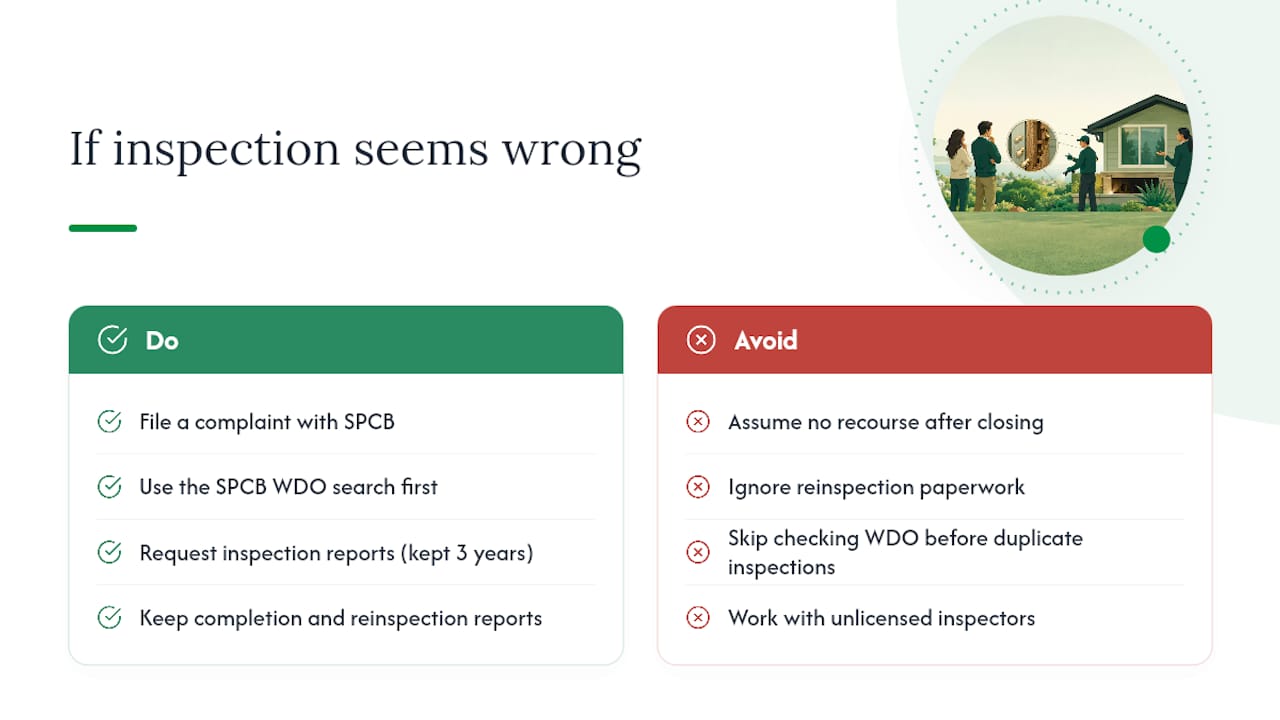
Start with the Structural Pest Control Board itself. You can file a formal complaint against a licensed inspector, and the board investigates licensing violations, including failure to follow reporting requirements under BPC 8516. Companies are required to keep inspection reports on file for three years, so if you need to pull records for a dispute or a past inspection, that history should be retrievable.
You also have a direct verification tool before any dispute even starts. The SPCB's WDO search lets you check whether a specific property has been inspected within the past two years, which is worth doing before you ever pay for a duplicate inspection.
If a repair or treatment didn't hold, and the property was reinspected and certified as clear, that paper trail matters enormously in any later claim. Keep every completion notice and reinspection report from your transaction, even after you've closed. If a dispute escalates beyond a board complaint, these documents become the backbone of any civil claim regarding misrepresentation or negligent inspection.
None of this replaces working with reputable, licensed inspectors from the start. But knowing the recourse exists changes how you negotiate if something does go sideways after the ink is dry.
Why Some Termite Damage Never Shows Up on the Report
Every WDO report carries a built in limitation: inspectors can only document what's visible and physically reachable. That's not a loophole in the system. It's the nature of the inspection itself, and it means a clean report doesn't guarantee a termite-free structure.
Drywood termites, in particular, tend to colonize wall voids, behind stucco, and inside roof structures that no inspector can open without demolition. Subterranean termites can build mud tubes through foundation cracks that stay hidden behind finished walls or under flooring until damage is already extensive. If a report lists an area as inaccessible, that's not the inspector being cautious for no reason. It's a genuine blind spot.
This is exactly why the inaccessible areas section of your report deserves more attention than most buyers give it. If a crawlspace access panel was too small, or a section of subarea was blocked by stored belongings, ask whether that access can be opened up before you close. It's a reasonable request, and a seller motivated to close usually accommodates it.
Older homes carry more of this risk simply because they've had more decades for hidden colonies to establish. If you're buying a property built before the 1980s, especially anywhere near the coast where moisture and termite pressure both run higher, budget mentally for the possibility that a clean inspection today doesn't rule out a discovery two years from now.
Resolving Disagreements Between Buyer, Seller, and Inspector
Disagreements over inspection findings happen more often than most first-time buyers expect, and they usually fall into one of two categories: a dispute over what the report actually says, or a dispute over who pays to fix it.
Start by rereading the report itself, together if possible. A surprising number of disputes come down to a misread Section 2 item being treated as urgent, or a Section 1 finding being downplayed. If the report language is ambiguous, contact the inspecting company directly and ask for written clarification. Under BPC 8516, licensed companies are obligated to stand behind what they've documented.
If the disagreement is about cost allocation rather than the finding itself, that's a negotiation between buyer and seller, not the inspector's problem to solve. This is where a second inspection or a contractor's independent bid earns its cost. Getting an outside opinion on scope and price gives both sides a neutral reference point instead of dueling assumptions.
When talks stall entirely, your escrow officer can often mediate procedural questions, like whether a deadline has technically passed. Your real estate agent should be the one pushing the actual negotiation forward. And if you genuinely believe an inspector missed something material or misrepresented a finding, that's when a formal complaint to the Structural Pest Control Board becomes the right move rather than an argument that goes nowhere between buyer and seller.
Getting Your Home Ready for an Accurate Termite Inspection
An inspector can only report on what they can actually see and reach, so a little preparation before the appointment makes a real difference in report accuracy.
Clear access to crawlspaces, attics, and the garage subarea days ahead of time. If storage boxes or furniture block the panel leading to your subarea, that space gets marked inaccessible, even if it's perfectly fine underneath. Trim back plants and shrubs touching the exterior walls, since wood-to-soil contact and vegetation pressed against siding are both common Section 2 flags that are easy to fix before the inspector even arrives.
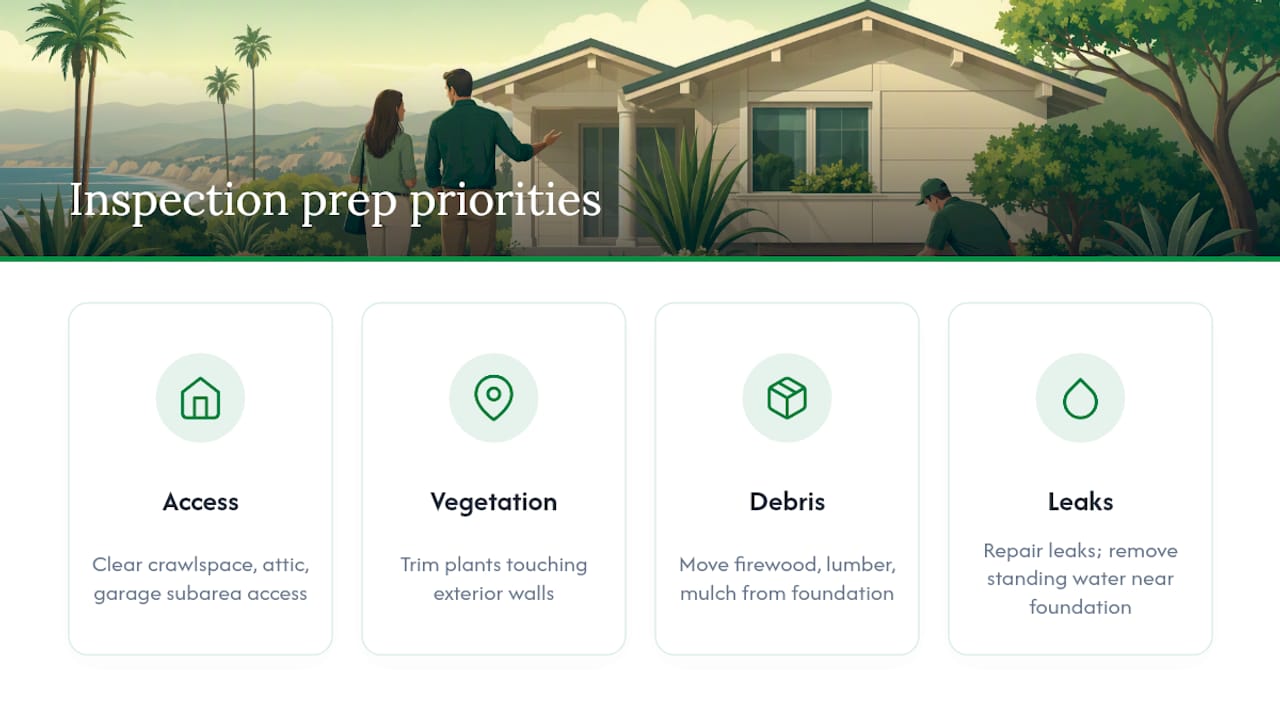
Move firewood, lumber, and mulch piles away from the foundation. These are classic conducive conditions, and clearing them beforehand can eliminate a flag entirely rather than leaving you to negotiate it later. Repair any obvious leaks or standing water near the foundation too, since moisture is one of the biggest predictors of both subterranean termite activity and wood decay fungus.
If you've had prior pest treatment or a past WDO report, have that paperwork ready for the inspector to review. It gives useful context and can speed up their assessment of areas that were previously treated. A little effort here doesn't guarantee a clean report, but it does guarantee the report reflects your home's real condition rather than access limitations you could have fixed in an afternoon.
Termite Activity Changes by Season and Region Across California
Termite pressure isn't uniform across California, and knowing your local pattern helps you judge how urgent an inspection really is. Subterranean termites tend to swarm in spring after rain, when soil moisture is highest and temperatures start climbing. Drywood termites, more common along the coast, often swarm in late summer and fall instead.
Coastal counties, including Santa Cruz, Monterey, and much of the Bay Area, see heavier drywood termite pressure thanks to consistent humidity and older housing stock. Inland and Central Valley regions deal more with subterranean termites, driven by irrigation, soil contact, and warmer ground temperatures for more of the year.
If you're selling a coastal property, don't assume winter inspections tell the whole story. A property inspected in January might look completely different by September once drywood termites swarm and colonies become active enough to spot. UC IPM recommends inspecting every three to five years under normal conditions, but tightens that to more frequent checks if you've had a prior infestation or live in a higher-risk zone.
For anyone selling or buying in Santa Cruz County specifically, this seasonal variation is worth raising with your agent before you set an inspection date. Timing an inspection right after a dry spell, versus right after weeks of rain, can genuinely change what an inspector finds.
How Desantis Realty Group Keeps Inspections From Derailing Escrow
We've walked enough Santa Cruz County transactions through termite findings to know where things typically go sideways: a seller who didn't disclose a prior report, a buyer who waited too long to schedule, or a Section 1 finding that catches everyone off guard three days before closing.
Part of representing a client well means handling the logistics most buyers and sellers never see. That means scheduling the inspection at the right point in escrow, vetting the inspector's SPCB license before anyone signs a contract, and reading the report closely enough to catch a vague inaccessible-area note before it becomes a problem at closing. When repairs are needed, we help gather contractor bids, separate treatment costs from repair costs, and negotiate the scope rather than just the price.
Since 2020, Desantis Realty Group has closed more than $200 million in transactions across Santa Cruz County, Monterey, and Silicon Valley. That volume means we've seen how termite findings play out across dozens of escrows, and where a proactive move saves a deal that could have stalled.
— Team
Get Local Help Coordinating Your Inspection and Escrow
Desantis Realty Group gives you something a generic pest control listing or a solo escrow process can't: a local agent who's already vetted the inspectors, knows which findings actually stall a loan, and negotiates repairs as part of the bigger deal, not as a separate headache you handle alone.

When you work with us, we coordinate the WDO inspection timing around your escrow deadlines, confirm the inspector's SPCB license before anyone steps foot on the property, and sit at the table when repair scope and credits get negotiated. That's the difference between discovering a Section 1 finding on your own three days before closing and having someone who already has a contractor bid ready to go.
If you're buying in Santa Cruz County, start with our first-time home buyer guide for a full walkthrough of what escrow looks like from offer to keys. If you're selling and want to get ahead of a termite report before it ever reaches a buyer's desk, our seller's guide covers how to prep your home and avoid last-minute surprises. Reach out through either page, and we'll walk you through exactly what your specific transaction needs next.