

A supplemental tax bill in California is a one-time, prorated charge triggered by a change in ownership or completed new construction, calculated under Revenue & Taxation Code §75. If one lands in your mailbox, open it immediately, confirm the event date and mailing date printed on the notice, then calendar two things: the 60-day appeal window and the installment due date. This bill comes in addition to your regular annual property tax, and it's usually mailed to you, not your lender.
TL;DR:
- Owners should expect supplemental tax bills four to twelve months after a property transfer or completed construction, depending on county processing times.
- Bills for events between January 1 and May 31 typically come in two installments, covering remaining and upcoming fiscal years, while June to December events usually generate only one prorated bill.
- Reassessments happen when a property’s value changes due to ownership transfer, new construction, or significant improvements, with some transfers qualifying for exclusions if properly documented.
- The calculation involves determining the new assessed value, subtracting the prior value, applying the tax rate, and prorating based on remaining fiscal months, often resulting in split bills.
- The 60-day appeal window is tight, and owners should immediately gather supporting documents and file appeals on time to contest incorrect supplemental assessments.
Table of Contents
- What Triggers a Supplemental Assessment in California?
- When Will You Get a Supplemental Tax Bill, and How Many?
- How Is the Supplemental Tax Calculated?
- When Are Supplemental Tax Payments Due?
- Can You Get a Refund From a Supplemental Assessment?
- How Do You Appeal a Supplemental Assessment?
- How Do Supplemental Bills Play Out in Real Transactions?
- What Local Practice Prevents Supplemental Bill Surprises?
- Where to Find Official Supplemental Tax Information
- Perspective: The Supplemental Bill Problem Nobody Talks About
- Sources
What Triggers a Supplemental Assessment in California?
A supplemental assessment fires whenever your county assessor learns the property's value changed outside the normal January 1 lien date cycle. The legal trigger is narrow, but the real-world list of qualifying events is long. Under RTC §75, two categories create a supplemental event: a change in ownership and completed new construction.
A change in ownership covers most sales, many gifts, and certain trust transfers. Completed new construction covers anything that adds value to the parcel beyond ordinary maintenance. Assessors don't have to guess when these events happen. They find out through recorded deeds, building permits pulled from the county building department, and self-reported forms like the Preliminary Change of Ownership Report filed at closing.
Common triggers you'll see across Santa Cruz County and neighboring markets include:
- A home sale or purchase, including most family transfers that aren't spousal or otherwise exempt
- Construction of an accessory dwelling unit, which almost always re-triggers assessment on the new square footage
- Room additions, second-story pop-tops, and garage conversions to living space
- Pool installations, since they add assessable value even though they're outdoors
- Major renovations that go beyond repair and maintenance, such as a full kitchen or structural rebuild
Not every transfer counts. Interspousal transfers, certain revocable trust transfers where the original owner remains the beneficiary, and a handful of parent-child transfers under Proposition 19 rules can be excluded from reassessment. The exclusions carry their own paperwork requirements, so don't assume you qualify just because a transfer feels informal. If you skip the required ownership-change filings, you risk penalties under RTC §482, so file the paperwork even when you expect an exclusion to apply.
When Will You Get a Supplemental Tax Bill, and How Many?
Timing frustrates almost everyone, because the supplemental bill rarely shows up right after closing. Sacramento County's assessor office notes bills typically arrive four to twelve months after the triggering event, depending on how fast the recorder's office processes the deed and how backed up the assessor's appraisal queue is that quarter.
County size matters here. A rural or mid-size county might turn a supplemental around in four to six months. Larger counties, where appraisal staff are working through thousands of recorded transactions, often stretch closer to the twelve-month mark, and some counties batch supplemental notices quarterly rather than mailing them as each parcel gets finalized.
The month your event falls in determines whether you get one bill or two:
- Events between January 1 and May 31 generally trigger two supplemental assessments: one prorated for the remainder of the current fiscal year, and a second covering the upcoming fiscal year, as Los Angeles County's property tax portal explains.
- Events between June 1 and December 31 typically generate just one supplemental bill, prorated for the months remaining in that same fiscal year.
If you bought a home in March, expect two separate notices rather than one larger bill. That catches a lot of buyers off guard, since they've budgeted for a single unexpected charge and then a second one shows up months later.
How Is the Supplemental Tax Calculated?
The math behind a supplemental tax bill California owners receive follows a fixed sequence, and once you've walked through it once, it stops feeling mysterious.
Step 1: The assessor sets a new base year value, usually the purchase price for a sale or the appraised value of completed construction.
Step 2: Subtract the prior assessed value from that new base year value. This difference is the amount actually being taxed.
Step 3: Multiply the difference by your total tax rate, generally the base 1% rate plus any voter-approved local debt or special assessments layered on top for your area (school bonds and community facilities districts are common additions in Santa Cruz County).
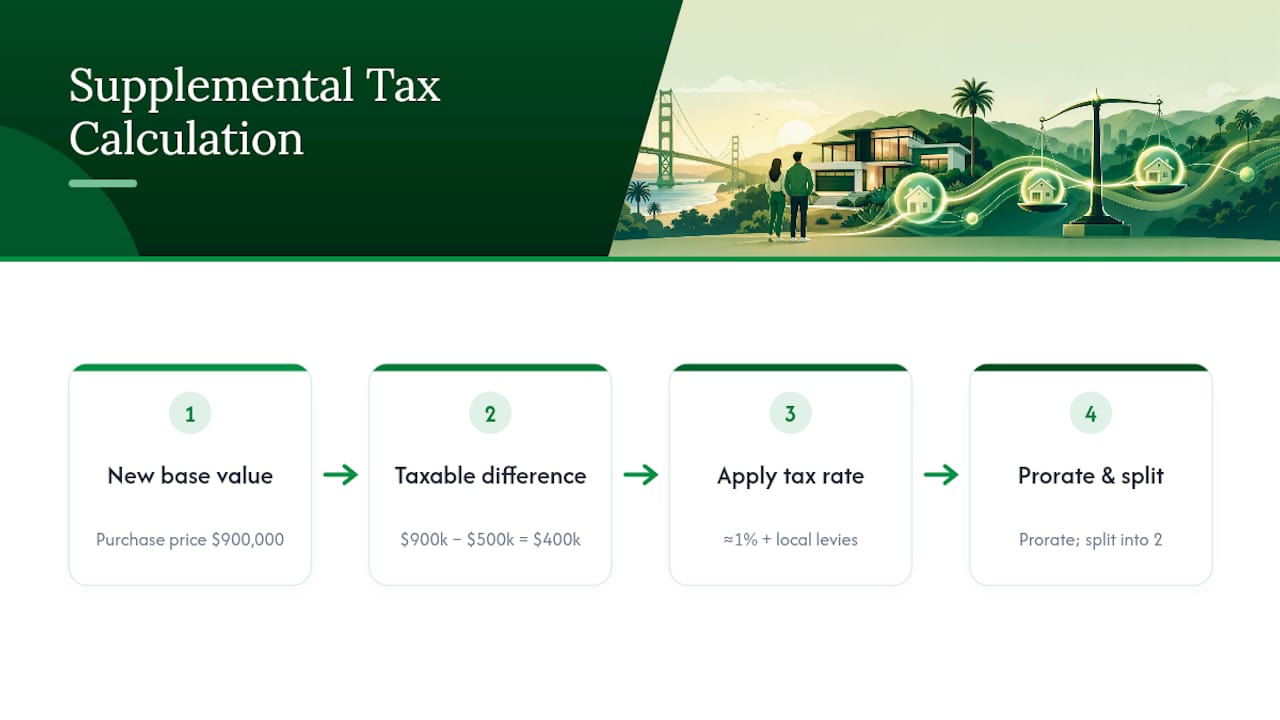
Step 4: Apply the proration factor based on how many months remain in the fiscal year after your event date. The BOE publishes this factor table, and county auditor-controllers apply it directly to your bill.
Worked example: Say you bought a home in Santa Cruz County in November for $900,000, and the prior assessed value was $500,000. The difference is $400,000. With several months remaining in the fiscal year, the proration factor is applied accordingly, so your actual supplemental bill is prorated and typically split across two installments.
Pro Tip: Before you get a bill in hand, pull your county assessor's parcel record online and check the prior assessed value yourself. Several counties, including Kern and Orange, post supplemental estimator tools that let you plug in a sale price and get a rough bill amount before the official notice ever arrives.
When Are Supplemental Tax Payments Due?
Supplemental installment due dates hinge on when the county mails your bill, which is why two neighbors with similar purchase dates can end up on different payment schedules.
If the bill is mailed between July and October, the first installment is generally due in early November and becomes delinquent about a month later; the second installment is due in February and delinquent about two months later, following the regular tax calendar pattern. If the bill is mailed later in the fiscal year, the county typically sets custom delinquency dates printed directly on the notice, often giving you roughly a month before the first installment becomes overdue.
Miss those dates and the penalties are steep and automatic:
- A penalty applies to any delinquent installment, assessed immediately after the deadline
- An additional cost is added to a delinquent second installment on top of the penalty
- Extended non-payment risks additional redemption penalties and, eventually, default proceedings against the parcel
If a due date is going to be tight, don't wait for a collection notice. Call your county tax collector's office directly, since Kern County and similar offices list payment portals, phone numbers, and, in some cases, penalty cancellation procedures for owners who can document a legitimate hardship or processing delay. Some counties also offer four-pay or other installment arrangements for supplemental amounts above a certain threshold, worth asking about before you assume a lump sum is your only option.
Can You Get a Refund From a Supplemental Assessment?
Reassessment doesn't always raise your bill. When a completed sale or new construction event results in a lower value than the prior assessment, the county issues what's called a negative supplemental assessment, and instead of a bill, you get a refund.
The auditor-controller's office calculates and issues these refunds automatically once the reassessment is finalized, so you typically don't need to file a separate claim to receive one. That said, refunds move on their own timeline, entirely separate from your annual tax bill.
Here's the part that trips people up:
- A pending or expected refund never offsets your regular annual property tax. You still owe the annual bill in full, on schedule, regardless of a refund working through the pipeline.
- If your reassessment showed a clear value drop (a post-purchase market correction, for instance) and months have passed with no refund, contact the county auditor-controller directly rather than the assessor, since refund processing sits with that office.
- Keep your closing documents and any appraisal paperwork handy. If the refund amount looks off, that paperwork is what you'll need to question it.
How Do You Appeal a Supplemental Assessment?
The appeal clock on a supplemental assessment moves faster than most owners expect. You generally have 60 days from the mailing date of the supplemental notice to file, under RTC §1605, which is considerably tighter than the regular annual assessment appeal window most owners are used to.
Here's how to work the appeal without missing a step:
- Pay the bill on time regardless. Filing an appeal doesn't pause your payment obligation, and unpaid installments still accrue the standard penalties even mid-appeal.
- Gather your evidence early. Comparable sales that closed near your event date, contractor invoices showing actual construction costs, and permit closeout documents all carry weight with an appeals board.
- File with the county assessment appeals board using the forms your county assessor's office provides, referencing BOE guidance where the form asks for statutory basis.
- Keep copies of everything you submit, including the date-stamped filing confirmation, since the 60-day window leaves no room for a lost paperwork dispute later.
- If the appeal succeeds, the county issues a corrected bill or a refund for amounts already paid at the higher assessment.
Appeals built around non-arm's-length sales, like a transfer that included seller concessions or below-market family pricing, need extra care. Present comparable sales that exclude those concessions so the board sees the property's real market value, not a distorted purchase price.
Pro Tip: If your appeal involves new construction costs, a licensed appraiser's written opinion often carries more weight with an appeals board than your own cost estimate, especially for additions or ADUs where "market value added" and "construction cost" aren't the same number. Well-documented appeals with clear invoices and comparables tend to succeed more often than those filed without supporting evidence, according to industry appeal guidance.
How Do Supplemental Bills Play Out in Real Transactions?
Supplemental tax bills feel abstract until you map them onto an actual closing, so here's how they show up in the scenarios we see most often.
Buying a home. The bill goes to you, the new owner, not automatically to your lender. Loan servicers aren't required to receive supplemental notices, which is exactly why they get missed. The moment you close, confirm with your loan servicer whether supplemental amounts will be added to your impound account or billed to you directly, since assuming your escrow account has it covered is the single most common way owners end up delinquent.
New construction or renovation. Pulling a permit for an ADU, addition, or pool essentially guarantees a supplemental reassessment once the county closes out the permit. Keep every contractor invoice and the final permit sign-off. That paperwork becomes your evidence if the assessor's added value estimate runs higher than what you actually spent.
Multiple events in one year. A sale followed by a fast renovation, or a construction project that spans two ownership changes, can generate more than one supplemental bill stacked in the same fiscal year. When that happens, liability generally follows the ownership timeline at each event date, which is exactly why closing paperwork needs to spell out who's responsible for what.
What Local Practice Prevents Supplemental Bill Surprises?
The supplemental system isn't broken, but it's built on an assumption that everyone involved in a transaction is talking to each other. In practice, they usually aren't, and that gap is where owners get blindsided.
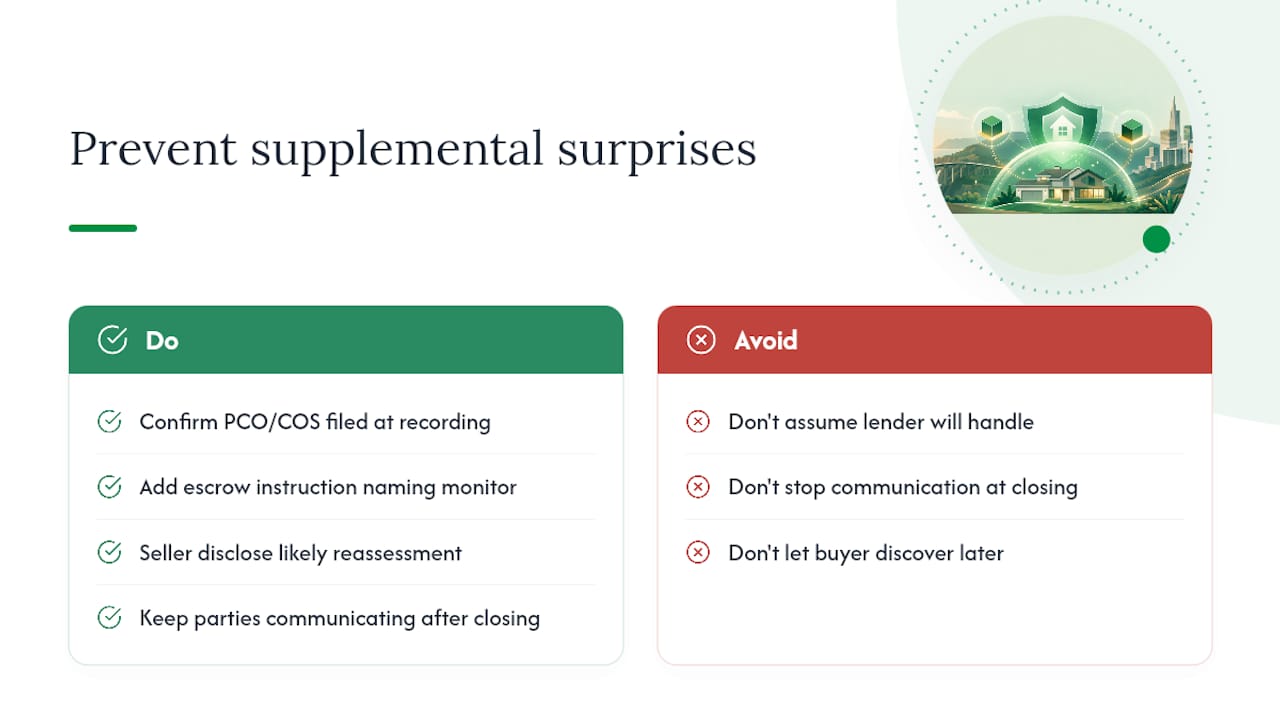
We tell every client the same thing at closing: confirm the Preliminary Change of Ownership Report and Change of Ownership Statement are actually filed at recording, not just prepared. Then build a specific line into your escrow instructions naming who watches for the supplemental notice, because "the lender will handle it" is the assumption that causes most missed deadlines.
Communication between seller, buyer, lender, and escrow shouldn't stop at the closing table. If a seller knows a supplemental is likely, because they added a bathroom two years ago and never saw the reassessment land, they should say so during disclosure, not leave the buyer to discover it eight months later.
Many clients experience supplemental tax confusion during transactions in Santa Cruz County, which is often resolved by asking the right question at the right moment. If you're navigating a purchase, sale, or renovation that could trigger reassessment, our seller's guide and buyer's guide walk through the closing checklist in more detail, and you can always reach out directly for help coordinating the post-close steps that keep a supplemental bill from becoming a surprise.
Where to Find Official Supplemental Tax Information
Bookmark these before you need them, not after a bill lands in your mailbox.
The BOE supplemental assessment page is the authoritative source for the statutory framework and proration methodology. Your county assessor and tax collector pages, whether that's Los Angeles, Sacramento, Santa Clara, or Kern, carry your local payment portal, due dates, and appeal forms. If your reassessment touches business personal property alongside real estate, Tolliver's guide to Form 571-L covers that separate filing requirement. Look up your parcel number on your county assessor's site now, before a notice forces the search.
Perspective: The Supplemental Bill Problem Nobody Talks About
The real issue with supplemental tax bills isn't the math. Once you see the formula, the proration table, the whole thing is almost mechanical. The real issue is timing psychology: owners budget for costs that arrive on a predictable schedule, and a supplemental bill breaks that pattern by design. It shows up four months later, or twelve, disconnected from the transaction that caused it.
That gap is where most of the anxiety lives, and most advice online doesn't address it. Guides to explain the formula in detail and then leave you to figure out the emotional part yourself, the part where you're wondering for half a year whether a bill is still coming.
Our honest take: the fix isn't a better calculator. It's calendaring the event date the moment it happens, not waiting for the notice to remind you. Set a reminder for month four, and another for month twelve, tied to your closing or permit finalization date, not to some bill you haven't received yet. Owners who do this treat the eventual notice as confirmation of something they already expected, rather than a shock. That single shift in when you start paying attention changes the entire experience, from dread to a checked box on a list you already had.
— Team
Sources
- Supplemental Assessment | California State Board of Equalization
- Supplemental Secured Property Tax Bill | Los Angeles County Property Tax Portal
- Supplemental Assessments | Sacramento County Assessor
- Supplemental assessments | Santa Clara County (appeal guidance)
- Supplemental Taxes | Kern County Treasurer and Tax Collector