

California sellers pay a total commission averaging 5.47% of the sale price, split roughly evenly between the listing agent and the buyer's agent. Sellers still typically cover both sides in practice, even though nothing legally requires it anymore. AB-2992 didn't change who pays. It changed how buyer-agent compensation gets disclosed, documented, and timed before an offer is ever written.
TL;DR:
- Sellers are still financially responsible for both sides in practice, as buyers usually do not cover their agents' fees, especially in competitive markets or higher price ranges.
- Under AB-2992, buyer-broker agreements must be signed before an offer, clearly stating compensation, service scope, and expiration date within three months, affecting how agreements are managed.
- Agent commission splits generally run through the brokerage, with typical agent net income ranging from 30% to 50% of their gross fee after expenses and brokerage cuts.
- Negotiation and strategic structuring of commissions, along with understanding what services are included, are essential for buyers and sellers to maximize value and net proceeds.
Table of Contents
- What Is the Average Real Estate Commission in California?
- Who Actually Pays the Commission Now?
- What Changed Under AB-2992 and the NAR Settlement?
- How Commissions Get Split Between Agents
- How to Negotiate or Reduce Your Commission Costs
- What to Check Before Signing a Buyer Agreement
- Ten Questions to Ask Before Choosing Your Agent
- The Santa Cruz Market Reality Behind the Statewide Numbers
- How Desantis Realty Group Can Help With Your Commission Questions
- Sources
What Is the Average Real Estate Commission in California?
California's statewide average total commission sits at about 5.47%, broken into roughly 2.73% for the listing side and 2.74% for the buyer's side. That's close to a clean 50/50 split, though the exact number on any given deal depends on negotiation, price point, and how motivated the seller is to move quickly.
Run those percentages against real California price points and the dollar amounts get concrete fast:
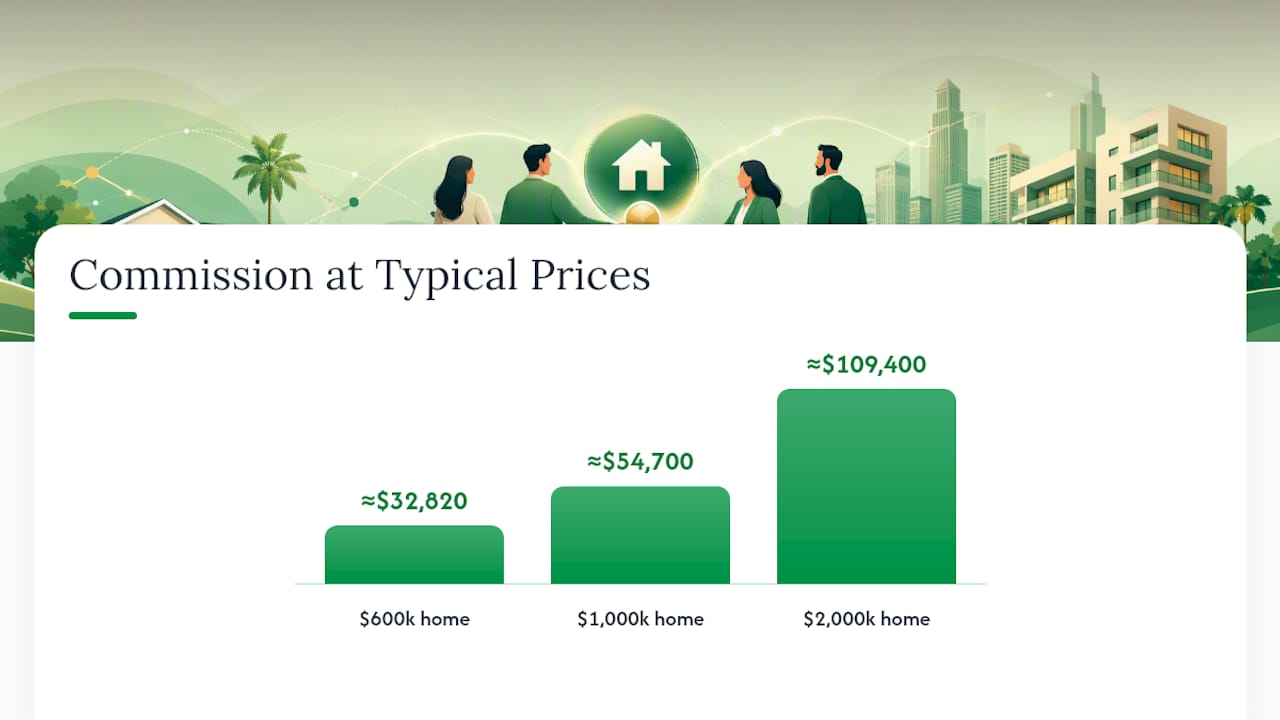
- $600,000 home (a common price in inland or entry-level coastal markets): roughly $32,820 total commission, about $16,400 per side.
- $1,000,000 home (typical for much of Santa Cruz County and the greater Bay Area): roughly $54,700 total, about $27,350 per side.
- $2,000,000 home (a realistic figure for coastal Santa Cruz, Monterey, or Silicon Valley luxury inventory): roughly $109,400 total, about $54,700 per side.
Quick benchmark: at the state average of 5.47%, every $100,000 of sale price adds about $5,470 in total commission, split close to evenly between the two agents involved.
Treat these figures as planning benchmarks, not fixed rules. Survey methodology varies. Some surveys poll a smaller pool of responding agents than others, and coastal markets with high price points and heavy competition for listings often land at the higher end of the range while inland markets and discount brokerages pull the average down. A seller in a hot Santa Cruz County micro-market with multiple offers has more leverage to negotiate a lower listing fee than a seller in a slower-moving inland market where agents are doing more work to generate interest.
Who Actually Pays the Commission Now?
Here's the legal reality: each client, buyer and seller alike, signs a contract with their own agent and is technically on the hook for that agent's fee. A seller signs a listing agreement obligating them to pay their listing agent. A buyer, under the newer rules, signs a buyer-broker representation agreement obligating them to pay their own agent. Nothing forces a seller to pay the buyer's side.
In practice, sellers still usually do. Offering a buyer-agent concession keeps a listing competitive, because most buyers either can't or won't stretch their offer to cover their own agent's fee on top of the purchase price. Market coverage of the settlement rollout confirms this pattern has held steady across California even though the MLS no longer guarantees an automatic buyer-agent offer.
What happens if a seller declines to offer any concession? A few scenarios tend to play out:
- The buyer negotiates it into the price, asking the seller to credit the commission amount at closing instead of paying it directly.
- The buyer's agent asks the buyer to cover the fee out of pocket, which can shrink the buyer's effective purchasing power by tens of thousands of dollars.
- Cash buyers and investors sometimes skip agent representation entirely, removing the question from the table.
Sellers who refuse any buyer-side concession risk narrowing their buyer pool, particularly in price ranges where buyers are already stretching their budgets. For a deeper look at how these costs show up at the closing table, our buyer closing costs guide for Capitola breaks down where commission dollars land alongside other fees.
What Changed Under AB-2992 and the NAR Settlement?
AB-2992 didn't touch commission rates. It rewired the paperwork and timing around buyer representation, and that shift matters more than most sellers realize.
The California Department of Real Estate's consumer alert lays out the core change: buyer-broker representation agreements (BRAs) must now be signed no later than when a buyer submits an offer, and the agreement has to spell out compensation terms in writing before that happens. No more verbal understandings or "we'll figure it out at closing."
The statutory text of AB-2992 gets specific about what a compliant BRA must include:
- Compensation terms, stated clearly, not buried in fine print.
- A description of services the agent will provide in exchange for that compensation.
- An expiration date, capped at three months for individual buyers on the initial term.
- No automatic renewal. Any extension has to be a new, written, signed agreement.
That three-month cap is worth pausing on. It means a buyer isn't locked into one agent for a full home search cycle without the chance to reassess. If the relationship isn't working, the agreement lapses on its own rather than rolling forward silently.
Separately, the nationwide NAR settlement stripped the requirement that listing agents offer a set buyer-agent commission through the MLS. That's the mechanism behind the "commissions are negotiable now" headlines, but as covered above, the practical effect on who pays has been smaller than the headlines suggested.
The DRE also issued a licensee advisory reminding agents of their compliance obligations under the new framework, reinforcing that these aren't optional best practices. They're enforceable standards tied to license status.
How Commissions Get Split Between Agents
The total commission doesn't go straight into an agent's pocket. It flows through a chain, and each link takes a cut.
A seller's payment goes first to the listing brokerage, which typically shares roughly half with the brokerage representing the buyer, known as the cooperating broker split. From there, each brokerage pays its own agent according to that agent's individual split agreement, which commonly falls somewhere between 50/50 and 80/20 in the agent's favor depending on experience, production, and brokerage model.
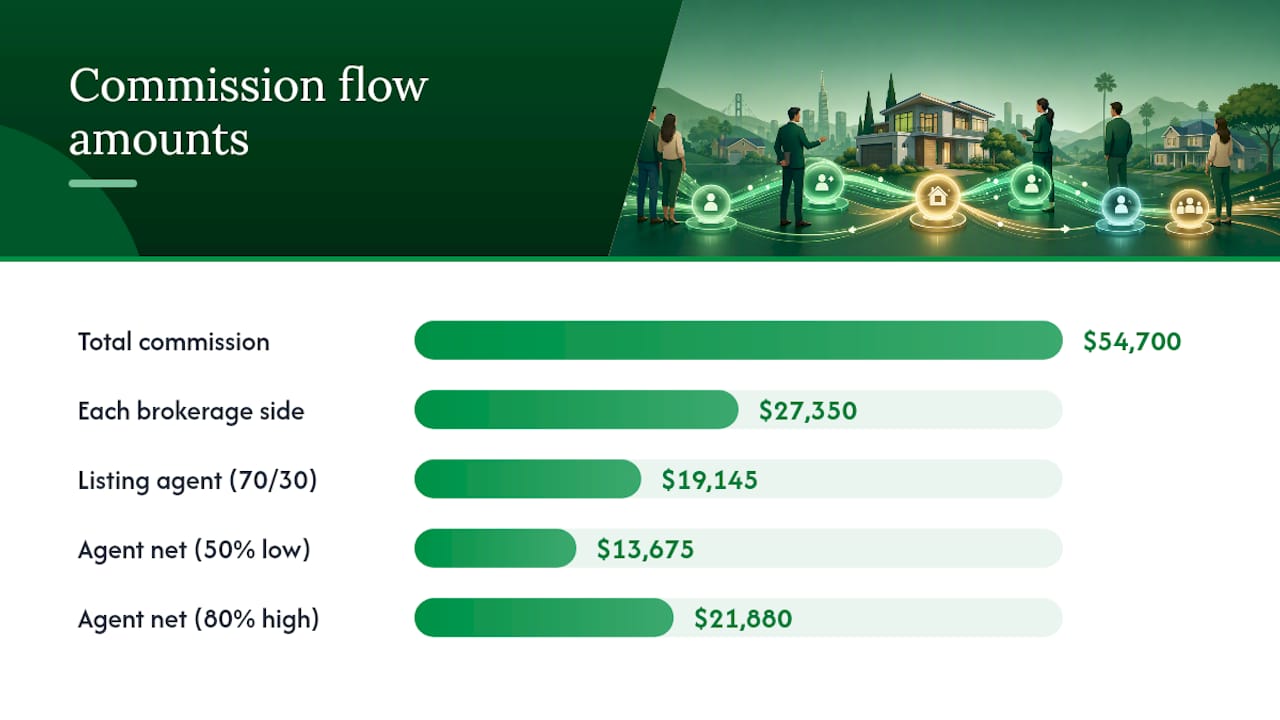
Here's a worked example using the state average. On a $1,000,000 Santa Cruz County sale at 5.47% total commission:
Quick math: $1,000,000 × 5.47% = $54,700 total commission, split roughly $27,350 to the listing side and $27,350 to the buyer side.
If the listing agent works on a 70/30 split with their brokerage, that agent nets about $19,145 before taxes and expenses, not the full $27,350. Industry data on agent compensation shows this gap between gross commission and actual take-home is standard, not an outlier.
Additional deductions can shrink that further:
- Franchise fees, common at national brand brokerages, often taking a percentage off the top.
- Transaction fees, flat charges some brokerages apply per closed deal.
- Referral fees, when an agent received the client through another agent or a lead-generation service.
An agent's real income on any given sale is often 30% to 50% lower than the headline commission number would suggest.
How to Negotiate or Reduce Your Commission Costs
Commission rates are negotiable, and they always have been. What changed is how openly that negotiation now happens on the buyer side too.
- Ask your listing agent directly what services justify their rate. A full-service agent handling professional photography, staging consultation, and a coordinated marketing plan earns their fee differently than one who lists your home and waits for the phone to ring.
- Consider a discount or flat-fee model if your home is likely to sell itself. These arrangements typically exclude the negotiation support, marketing budget, and hands-on transaction management a full-service agent provides, so weigh that tradeoff before assuming lower is better.
- Structure a buyer concession strategically rather than automatically. In a market with plenty of comparable listings, offering a competitive buyer-agent fee can be the difference between multiple offers and none.
- Model your net proceeds, not just your commission rate. A seller who saves 1% on commission but accepts a lower offer because their listing lacked marketing reach can come out behind a seller who paid full rate and sold faster, at a higher price.
Pro Tip: Before choosing a discount brokerage to save on the listing side, ask exactly which tasks fall to you. Some flat-fee models leave scheduling, negotiation, and paperwork review in the seller's hands, which can cost more in time and mistakes than the commission you saved.
What to Check Before Signing a Buyer Agreement
Under AB-2992, the buyer-broker representation agreement is no longer a formality. It's a binding document you should read the way you'd read any contract with real financial stakes.
Confirm these elements are spelled out before you sign:
- The exact compensation figure or formula, not a vague reference to "standard rates."
- What services are included, such as showings, contract negotiation, and inspection coordination.
- When payment is due and whether it's contingent on a successful closing.
- The expiration date, which can't exceed three months for an individual buyer's initial term.
Timing matters here too. Under DRE guidance, this agreement has to be signed no later than when you submit an offer, which means an agent should raise it early, not at the closing table. If an agent hands you a BRA to sign the moment you walk into a showing, that's a signal to slow down and read every line rather than sign on the spot.
Pro Tip: Ask specifically what happens if you find a property on your own, through a listing you spotted first, and whether your agent still collects a fee. That clause is one of the most commonly overlooked triggers in these agreements.
Negotiable terms include cancellation rights, what triggers a fee if you buy something your agent didn't show you, and whether renewal requires a fresh conversation about services and rate. For a walkthrough of what happens after you sign and move into contract, our step-by-step Capitola escrow guide covers where commission payments land in that timeline.
Ten Questions to Ask Before Choosing Your Agent
Comparing agents on personality alone leaves money on the table. Compare them on these specifics instead:
- What is your commission rate, and is it negotiable based on services?
- What exactly does that rate include, marketing, staging, photography, negotiation?
- What's your average days-on-market and sale-to-list price ratio on recent listings?
- Will you offer a buyer-agent concession, and at what percentage?
- What happens to the agreement if I want to cancel early?
- How long is the initial listing or buyer agreement term?
- Do you charge any transaction or administrative fees on top of commission?
- Can you show me a recent case where you negotiated commission or price successfully?
- How do you handle multiple offers, and does your fee change based on outcome?
- What's your plan if the home doesn't sell within the agreement term?
Red flags include vague answers about compensation, pressure to sign quickly, or resistance to putting fee terms in writing. If you're weighing multiple agents, our pre-listing question guide for Santa Cruz County walks through how to score answers side by side.
The Santa Cruz Market Reality Behind the Statewide Numbers
Statewide averages tell you what's typical. They don't tell you what happens on Seabright bungalows competing against six offers, or a Monterey view property that sits for four months because the price outran the market.
Many sellers in Santa Cruz County still offer a buyer-agent concession, even post-settlement, because the local buyer pool often includes move-up families and out-of-area buyers who are stretching their budgets. Cutting that concession to save a point on commission has, in more than one case we've watched play out locally, cost sellers a faster close and a cleaner offer from a well-qualified buyer who simply couldn't compete without agent support baked into the deal.
Full-service representation may earn its rate here due to factors like coastal inventory, older housing stock, and septic or well complications common outside city limits that require more hands-on negotiation than a flat-fee model typically covers.
— Team
How Desantis Realty Group Can Help With Your Commission Questions
Getting a clear answer on what you'll actually pay, or actually take home, shouldn't require a law degree. Real estate professionals can help Santa Cruz County and Monterey sellers understand commission structure, buyer-agent concessions, and net proceeds before signing a listing agreement, so the numbers align with expectations at closing.

If you're weighing whether a full-service listing makes sense for your property, start with a free home valuation to see where your home lands in today's market and what commission structure fits your situation. Buyers navigating a new buyer-broker representation agreement can also browse current Santa Cruz County listings while getting straight answers on fees and services before signing anything. And if your sale involves a fixer or a home that needs work before it hits the market, System Wide Services' California remodel cost guide is a useful starting point for budgeting repairs against your expected net. Consider requesting a commission review before listing or making an offer.
Sources
- Consumer Alert — Changes to real estate representation (DRE)
- AB-2992 Real Estate Law: buyer-broker representation agreements (LegInfo)
- Average Real Estate Commission in California: 2026 Survey (ListWithClever)
- Real estate agent commission rules change goes into effect in California (NBC Bay Area)