

A probate sale in California is the court-supervised or court-authorized sale of real property belonging to someone who died, conducted by the estate's personal representative to pay debts and distribute assets. The single most consequential fact for anyone touching one of these transactions is whether the representative holds full authority under the Independent Administration of Estates Act or if the sale requires formal court confirmation. Before marketing anything, confirm that authority level on the Letters Testamentary or Letters of Administration, then talk to probate counsel or a probate-experienced agent.
TL;DR:
- Full authority under the Independent Administration of Estates Act allows property to be sold quickly and privately without court confirmation or overbidding.
- Limited authority sales require court confirmation, proper notice, overbidding, and often a 90% appraised value floor, delaying the sale process.
- Marketing a probate property should only commence after authority is confirmed to avoid voiding the sale or increasing personal liability.
- Timelines vary by county due to court backlog and local procedures, with larger counties generally experiencing longer delays before hearings.
- Early coordination with probate counsel and experienced agents improves compliance, reduces delays, and ensures smoother sales in California probate processes.
Table of Contents
- What Are the Types of Probate Sale in California?
- How Do You Sell a Probate Property Step by Step?
- How Long Does a Probate Sale Take and What Does It Cost?
- How Should Buyers Approach a Probate Property?
- What Happens at Court Confirmation and Which Forms Matter?
- Practical Tips From Probate Listings
- What Causes the Most Delays in Probate Sales?
- How Do You Resolve Disputes or Objections During a Probate Sale?
- Do Probate Sale Procedures Vary by County?
- What Are the Tax Implications of a Probate Sale?
- What Should a Personal Representative Do First?
- Why California's Probate Sale Rules Reward Preparation, Not Speed
- How Probate Property Transactions Are Supported
- Sources
What Are the Types of Probate Sale in California?
California recognizes two distinct paths, and they lead to very different timelines. Getting this distinction right at the outset shapes everything that follows, from how you market the property to how long escrow drags on.
Full IAEA authority lets the personal representative sell the property much like a standard transaction. Once granted, the executor issues a Notice of Proposed Action to heirs and beneficiaries, waits 15 days for objections, and can close without ever appearing before a judge. No confirmation hearing, no overbidding, no probate referee dictating a floor price.
Limited or court-confirmed authority works differently. The estate must publish notice of the sale, hold a confirmation hearing, and allow overbidding in open court under Probate Code §10311. The probate referee's appraisal also matters more here, because Section 10300 through 10316 generally requires accepted offers to sit at or above 90% of that appraised value.
- Full IAEA: faster, private, fewer court appearances, no statutory overbid exposure
- Limited authority: slower, public, subject to the 90% appraisal floor and courtroom bidding
If the will or existing Letters don't grant full authority, the representative can petition the court to add it. Executors who secure that upgrade before marketing routinely save weeks or months compared with running the entire sale through confirmation.
How Do You Sell a Probate Property Step by Step?
Selling inherited property in California rewards preparation. Skip a step here and you risk a voided sale or personal liability for the representative, so treat this as a sequence, not a menu.
- Gather your documents first. Pull the death certificate, Letters Testamentary or Letters of Administration, a complete beneficiary list, an inventory of estate debts, and schedule the probate referee's appraisal.
- Confirm or request authority. If Letters already grant full IAEA authority, you're clear to proceed with Notice of Proposed Action. If not, your attorney petitions the court, which typically adds a few weeks before you can market.
- Choose your notice path. Full authority means a 15-day Notice of Proposed Action to interested parties. Limited authority means published notice in a newspaper of general circulation and a scheduled confirmation hearing.
- Market only after authority is confirmed. This is the step most representatives get wrong.
- Negotiate and accept an offer, understanding that a limited-authority sale is technically a starting bid the court can still raise through overbidding.
- Prepare your court filings if confirmation is required: the Report of Sale and Petition for Order Confirming Sale of Real Property (DE-260), the referee's appraisal, proof of publication, and a marketing log showing how the property was exposed to the market.
- Close escrow once the 15-day NOPA period expires without objection, or once the court confirms the sale at hearing.
Pro Tip: Never let a listing go live before the authority question is settled. Marketing a property before court approval is one of the most common reasons a probate sale gets voided, and it can expose the personal representative to personal liability for the delay it causes the estate.
How Long Does a Probate Sale Take and What Does It Cost?
Timing depends heavily on which authority path applies, and county calendars vary enough to swing your estimate by weeks. A full IAEA sale with no objections can close in a timeframe similar to a standard residential transaction once the 15-day notice period runs. A court-confirmed sale requires scheduling a hearing, which can be delayed in counties with busy court calendars.
Creditor-claim periods add another layer. Distributions to heirs typically wait until the claims window closes, even if the property itself sold months earlier.
Expect these cost categories to reduce net proceeds:
- Probate referee appraisal fees
- Publication costs for court-confirmed sales
- Attorney fees tied to petitions and confirmation
- Real estate commissions
- Escrow and title fees
A quick example: on a $700,000 sale, referee and publication fees might run a few thousand dollars, attorney fees for the confirmation petition another few thousand, and a standard commission structure taking a meaningful slice before escrow and title fees are even factored in. Referee appraisals commonly land below recent comparable sales, which matters directly in limited-authority sales because of the 90% floor.
How Should Buyers Approach a Probate Property?
Buying probate property in California means playing by different rules than a standard resale, and the rules shift depending on which authority path the seller is using.
- Deposits and contingencies differ by sale type. IAEA sales often move like conventional deals with standard contingency periods; court-confirmed sales frequently require a larger deposit and give the buyer less room to negotiate contingencies once the court sets a hearing date.
- Overbidding is real at confirmation hearings. Under Prob. Code §10311, the courtroom can open the floor to higher bids on the day of the hearing, and the original buyer can lose the property to a qualifying overbid.
- Inspections need to happen early, because a longer probate timeline means more time for a property to sit vacant, and vacant homes develop issues.
- Work with an agent who has handled probate transactions before. They'll verify the representative's actual authority, structure your offer to survive an overbid, and budget your expectations for a longer escrow.
What Happens at Court Confirmation and Which Forms Matter?
When a sale requires confirmation, the court is checking specific things: that the price meets the statutory floor, that notice was properly given, and that the sale terms are documented cleanly. Understanding the mechanics here helps both sides show up prepared instead of scrambling at the hearing.
The overbid formula under Probate Code §10311 sets the minimum increment a competing bidder must offer to be considered, and the statute generally directs the court to accept the highest qualifying offer unless it exercises discretion to order a new sale. Cash offers tend to carry more weight than credit-dependent bids in that moment, since the court is weighing certainty of closing alongside price.
- Report of Sale and Petition for Order Confirming Sale of Real Property (DE-260)
- Probate referee's appraisal
- Proof of publication and proof of required mailed notice
- A marketing log documenting how the property was exposed to buyers
| Filing or requirement | What it establishes |
|---|---|
| DE-260 | Reports sale terms and requests court confirmation |
| Referee appraisal | Sets the 90% statutory floor for limited-authority sales |
| Proof of publication | Confirms legal notice requirements were met |
| Marketing log | Demonstrates the property received fair market exposure |
Bring the representative, the listing agent, and probate counsel to the hearing. The court can decline to confirm a sale that looks underpriced or improperly noticed, which sends the whole process back to square one.
Practical Tips From Probate Listings
Handling probate listings across Santa Cruz County and neighboring counties, an experienced local real estate group coordinates directly with probate counsel and referee appraisers to compress timelines wherever the law allows. That means requesting full authority early when it's available, staging the Notice of Proposed Action so the 15-day clock starts the moment paperwork is ready, and keeping escrow documentation prepared before a buyer is even under contract. For groundwork on preparing any inherited property for market, the Seller's Guide covers the basics.
What Causes the Most Delays in Probate Sales?
Delays cluster around a handful of predictable failure points, and most of them are avoidable with better sequencing.
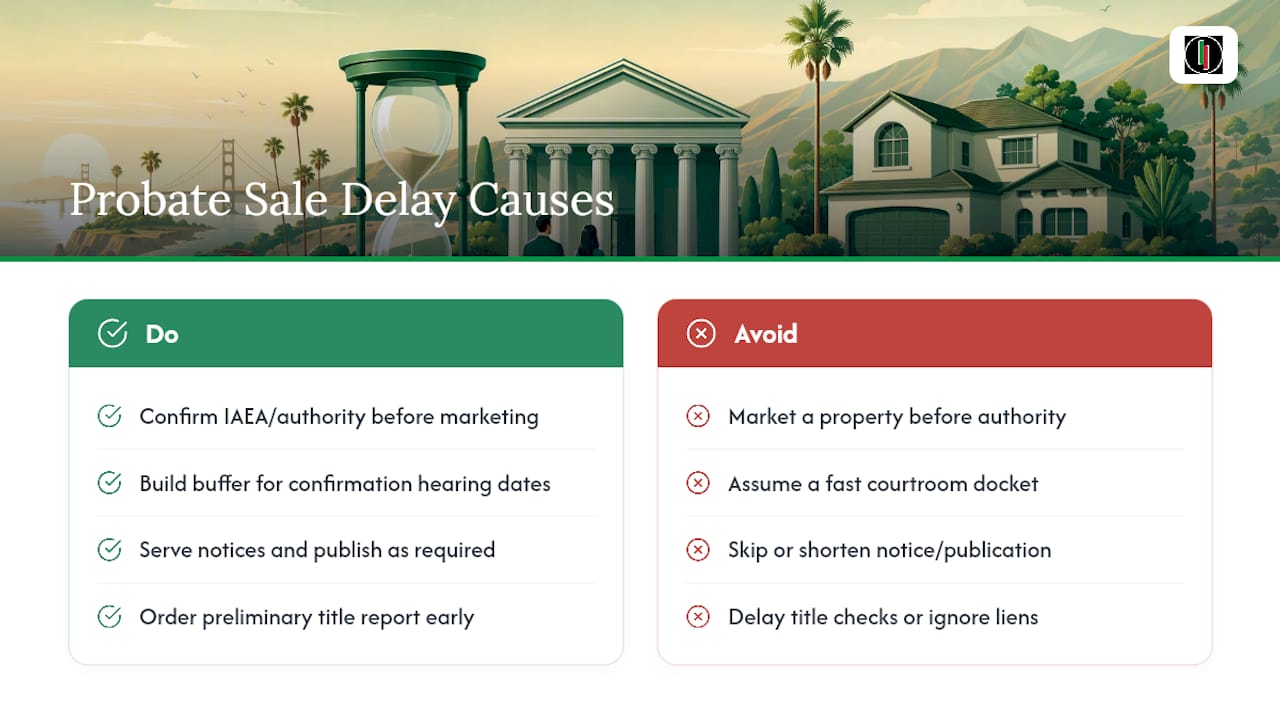
Marketing before authority is confirmed tops the list. An agent who lists a property before the representative has IAEA authority, or before a limited-authority petition is even filed, risks the sale being challenged or voided outright. Procedural compliance, not price negotiation, is the most common fixable failure point in probate transactions.
Court calendar backlogs stretch timelines in busier counties, particularly when a confirmation hearing gets pushed to a later date because the courtroom docket is full. There's no way to negotiate around a courtroom's schedule, so building in buffer time from the start avoids the frustration of an escrow deadline that assumed a faster hearing date.
Incomplete notice or publication forces a redo. If a required party wasn't properly notified, or the newspaper publication didn't run for the statutorily required period, the court can continue the hearing rather than confirm the sale.
Family disagreement over price or timing slows things even when the legal paperwork is flawless. Heirs sometimes disagree about whether to accept an offer, especially in a limited-authority sale where the referee's appraisal sits below what one heir believes the home is worth.
Title issues discovered late in the process, common with older or long-held family homes, can add weeks while liens or ownership questions get resolved. Ordering a preliminary title report early, well before you're negotiating with a buyer, catches most of these before they become a closing-day problem.
How Do You Resolve Disputes or Objections During a Probate Sale?
Objections during a probate sale generally come from one of three places: an heir who disagrees with the proposed price, a beneficiary who wasn't properly noticed, or an interested party who believes the sale process itself was flawed.
Under an IAEA sale, an objecting party's main tool is a restraining order. If someone files for one during the 15-day Notice of Proposed Action period, the sale effectively converts back to court supervision until the dispute is resolved. That's a significant procedural shift, since it strips away the speed advantage full authority was supposed to provide.
In a court-confirmed sale, objections typically surface at the hearing itself, where anyone with standing can raise a concern about price, notice, or process before the judge rules. The court has discretion to continue the hearing, request additional documentation, or reject the sale outright if the objection has merit.
The most reliable way to defuse a dispute before it escalates is early communication with heirs and beneficiaries, well before a hearing date or a NOPA deadline arrives. Representatives who circulate the referee appraisal, the marketing plan, and the proposed offer terms in advance give objecting parties a chance to raise concerns informally rather than in a courtroom. When a dispute can't be resolved that way, probate counsel needs to be involved immediately. Waiting to see if the objection "goes away" almost never works in the estate's favor, and it burns the very time a probate sale can least afford to lose.
Do Probate Sale Procedures Vary by County?
The statutory framework under the Probate Code applies statewide, but how quickly a case moves through the system depends heavily on the county's own courtroom capacity and local practices.
Larger counties with high probate case volume tend to have longer waits for hearing dates, simply because more estates are competing for the same courtroom calendar slots. Smaller counties can sometimes move faster, though they carry their own quirks, like less frequent hearing dates for probate matters specifically.
Some counties publish detailed local procedural guidance beyond what the state courts site covers, including local rules on required forms, filing fees, and preferred formatting for petitions. Santa Cruz County and the surrounding Central Coast counties follow the same statutory backbone, but local court staff and calendar availability still shape how a specific case unfolds week to week. Checking with local court self-help resources, alongside the statewide formal probate guidance, catches county-specific filing requirements before they become a surprise.
The practical takeaway: don't assume the timeline from a friend's probate sale in a different county applies to yours. Call the specific probate court clerk's office, or have your attorney do it, to confirm current hearing availability before setting expectations with heirs or buyers.
What Are the Tax Implications of a Probate Sale?
Heirs generally benefit from a stepped-up basis on inherited real property, meaning the property's tax basis resets to its fair market value as of the date of death rather than what the decedent originally paid. That stepped-up basis matters enormously for capital gains calculations if the property is sold shortly after inheritance, since much of the appreciation that occurred during the decedent's lifetime typically isn't taxed to the heirs.
The estate itself may face separate tax obligations depending on how long probate takes and whether the property generated income during that period, such as rental income while the sale was pending. Federal estate tax rarely applies to smaller estates given the high federal exemption threshold, but larger estates should have this evaluated specifically rather than assumed away.
California doesn't impose a separate state estate tax, but property tax reassessment is a real consideration. Proposition 19 changed how parent-child transfers are treated for property tax purposes, and a sale to an outside buyer during probate triggers standard reassessment at the sale price regardless of what the prior owner was paying.
None of this replaces guidance from a CPA or estate attorney familiar with the specific estate's numbers. Tax outcomes shift based on the property's value, how long it was held, and whether other estate assets complicate the picture, so treat these points as a starting framework for the conversation with a qualified professional, not a final answer.
What Should a Personal Representative Do First?
Before anything else moves forward, gather the foundational documents: the death certificate, Letters Testamentary or Letters of Administration, the will if one exists, a complete list of heirs and beneficiaries with current contact information, and any existing appraisal or valuation of the property.
Next, notify the people who need to know. Beneficiaries and heirs should hear from the representative directly, not find out about a pending sale through a public notice or a neighbor. Creditors also need proper notification within the statutory windows so their claim period runs on schedule rather than delaying final distribution later.
Hiring counsel early, ideally before filing anything with the court, prevents the single most common expensive mistake: marketing a property before the authority question is settled. A probate-experienced real estate agent should come on board around the same time as counsel, not after a petition is already filed, because early agent involvement helps time the referee appraisal, plan the marketing log the court will eventually want to see, and coordinate the Notice of Proposed Action or publication schedule around realistic market timing.
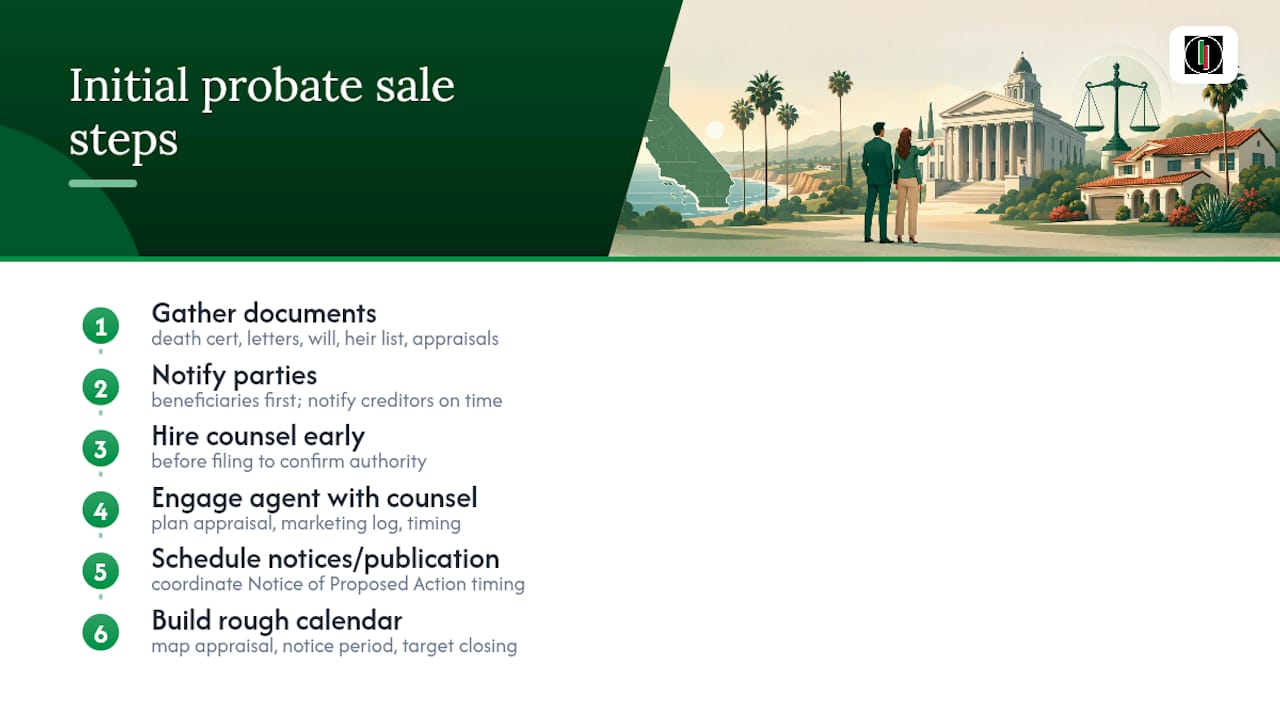
Finally, build a rough calendar. Even a loose timeline mapping the appraisal, the notice period, and a target closing window gives heirs a realistic picture instead of an open-ended guess, and it gives the representative a document to point to if anyone asks why the sale is taking the time it's taking.
Why California's Probate Sale Rules Reward Preparation, Not Speed
The conventional advice on probate sales tends to focus on speed, get the property listed, get an offer, get to closing. That advice misses what actually determines whether a sale goes smoothly: how well the authority question and notice requirements were handled before the property ever hit the market. A fast listing built on an unresolved authority question isn't fast at all. It's a sale that risks getting challenged, delayed, or voided at the worst possible moment.
What's overrated in most guidance I've seen is the emphasis on pricing strategy above procedural compliance. But a well-priced home sold without proper notice creates far more risk than a slightly conservative price sold correctly. Executors should prioritize getting the authority determination right first, then build marketing and pricing decisions on top of that solid foundation.
If there's one habit worth adopting from estates that move through probate cleanly, it's early coordination between counsel, the representative, and a local agent who has actually sat through a confirmation hearing. That combination catches problems while they're still cheap to fix.
— Mario Desantis
How Probate Property Transactions Are Supported
Selling or buying probate property in Santa Cruz County comes with a court calendar, a statute, and a family counting on you to get it right, and that's exactly where local, probate-specific experience pays off. Experienced agents work alongside probate counsel to keep marketing timelines aligned with authority approvals, so listings never jump ahead of what the court or the estate's Letters actually permit.

That coordination means executors get a marketing plan that survives court scrutiny and buyers get a clear read on where a property sits in the confirmation process. If you're a personal representative preparing to sell, the Seller's Guide walks through what to gather before listing. If you're evaluating probate inventory as a buyer, browse current property listings or reach out through Desantisrealty to schedule a consultation before you write an offer.
This article is general information, not a substitute for advice from a qualified lawyer. Consult a qualified legal professional about your own circumstances before acting on anything here.
Sources
- California Code, PROB 10311
- Report of Sale and Petition for Order Confirming Sale of Real Property (DE-260)
- California Courts Self-Help — Formal probate
- California Independent Administration of Estates Act (IAEA) — SettledEstate