

A California listing agreement is a written contract, required under Business and Professions Code §10018.14, authorizing a licensed broker to market and sell your property. Many Santa Cruz County sellers commonly sign an Exclusive Right to Sell agreement, formalized on the C.A.R. Residential Listing Agreement (RLA). Before you sign anything, confirm three things: the exact listing period and expiration date, how compensation is calculated, and whether the broker will submit your property to the MLS.
TL;DR:
- California law requires a fixed expiration date on all exclusive listing agreements to prevent indefinite commitments and ensure clear termination points.
- The most common and practical agreement is the Exclusive Right to Sell, providing agents with full marketing incentives regardless of who finds the buyer.
- Listing agreements should specify in detail the property description, asking price, compensation in dollar terms, and whether the property will be submitted to MLS.
- Cancellations should be handled with written notice through Form COL, with clear documentation of costs and protected buyer lists to avoid disputes.
- Negotiating a fair, transparent compensation structure and thoroughly reviewing the agreement before signing can improve outcomes and prevent future disagreements.
Table of Contents
- What is a listing agreement under California law?
- Types of listing agreements sellers commonly see in California
- What a listing agreement must contain
- How long can a listing agreement run in California?
- Commission, fees, and negotiating compensation
- How to cancel a listing agreement in California
- Where to find official C.A.R. listing forms
- Practical pre-signing checklist from Desantis Realty Group
- Why we typically recommend Exclusive Right to Sell
- Get your listing agreement reviewed before you sign
- Authoritative links and official forms
- Sources
What is a listing agreement under California law?
California doesn't leave this to interpretation. Business and Professions Code §10018.14 defines a listing agreement as a written contract between a seller and a real estate broker that authorizes the broker to sell the property, find a buyer, or perform any act that requires a real estate license. That last phrase carries weight. It means the agreement isn't just paperwork. It's the legal gateway that lets a broker advertise your home, negotiate offers, and represent you in a transaction that can involve hundreds of thousands of dollars.
The parties matter here too. You, the seller, sign with a broker or brokerage, not with an individual agent personally. The agent who walks your property and answers your calls works under that broker's license, and the brokerage carries the legal and financial responsibility for the listing. This structure protects you: if something goes wrong, there's an institution behind the transaction, not just one person's word.
Why does it have to be in writing? California's statute of frauds requires real estate contracts, including listing agreements, to be written and signed to be enforceable. A verbal promise from an agent, no matter how sincere, won't hold up if a dispute arises over commission or duties.
A properly executed listing agreement typically authorizes the broker to:
- Advertise and market the property, including photography, signage, and online listings
- Submit the listing to the Multiple Listing Service (MLS)
- Negotiate with buyers and buyer's agents on your behalf
- Present offers and counteroffers for your review and signature
- Coordinate with escrow, title, and other transaction participants
Without this signed authorization, a broker legally cannot represent you in a sale. That's the entire point of the document.
Types of listing agreements sellers commonly see in California
California recognizes a handful of listing structures, and the differences between them affect how hard your agent works, how much competition you create, and how much risk you carry.
-
Exclusive Right to Sell (C.A.R. RLA). This is the standard. One broker earns commission regardless of who finds the buyer, even if you find the buyer yourself. It sounds seller-unfriendly at first glance, but it's actually the arrangement that gets agents to invest real money in your listing. Professional photography, staging consultations, targeted digital ads. Agents commit that budget because they know they'll be paid when the home sells. The Residential Listing Agreement is the C.A.R. form used for this arrangement, and it's what the vast majority of California sellers sign.
-
Exclusive Agency (C.A.R. RLAA). Similar to the Exclusive Right to Sell, except you keep one carve-out: if you personally find the buyer without any agent involvement, you owe no commission. The C.A.R. Residential Listing Agreement, Agency form governs this version. It sounds appealing if you've got a likely buyer already in mind, a neighbor who's expressed interest, a family member, but understand the tradeoff. Agents tend to invest less marketing energy into a listing where they might do all the work and still get cut out of the payday.
-
Open Listing. Here, you can list with multiple brokers simultaneously, and only the one who produces the buyer gets paid. In theory, this creates competition. In practice, it's almost nonexistent for residential 1 to 4 unit properties in California. Brokers rarely commit marketing dollars, MLS access, or serious effort to a listing where a competitor could beat them to the finish line and take the entire commission. If you see this structure offered for your home, ask why.
-
Net listings and seller-reserved variants. A net listing sets a minimum amount you'll accept and lets the broker keep everything above that as compensation. California law permits these in narrow circumstances, but they're widely discouraged because they create an obvious conflict of interest. The broker's financial incentive runs directly counter to getting you the highest possible price. Most reputable California brokerages, including ours, won't write one.
For nearly every residential seller in Santa Cruz County, the Exclusive Right to Sell agreement remains the practical choice. It aligns your agent's financial interest with getting your home sold at the best price, and it's the form buyers' agents and MLS systems are built around.
What a listing agreement must contain
A listing agreement isn't a formality you skim and initial. Every field matters, and a few of them determine how much control and protection you actually have during the sale.
Here's what to verify before you sign:
- Party identification. Your legal name as seller, the brokerage name, and the individual agent's license number should all be correct and match your property title.
- Property description. The legal description and address must be accurate. Errors here can complicate title work later.
- Listing price. This is your asking price, not a guaranteed sale price, but it sets the marketing baseline and shapes buyer expectations.
- Start and end dates. Every exclusive listing needs an explicit expiration date. Vague or missing dates create disputes and can trigger DRE disciplinary scrutiny for the broker.
- Compensation clause. This spells out the total commission percentage or flat fee, and how it splits between the listing broker and a cooperating buyer's broker.
- MLS authorization. Confirms whether and when your property goes into the Multiple Listing Service, which is how most buyers' agents find listings.
- Marketing and cooperation duties. What the broker actually commits to doing: photography, signage, showings, syndication to sites like Zillow and Redfin.
- Disclosure provisions. Covers dual agency possibilities and your obligation to disclose known material facts about the property's condition.
Pro Tip: Ask your agent to write the compensation clause in plain dollar terms alongside the percentage. A 5% commission on a $900,000 Santa Cruz home is $45,000. Seeing the actual number before you sign avoids sticker shock at closing.
Two details deserve extra attention. First, dual agency. If your listing agent also represents the buyer in the same transaction, California requires written disclosure and your informed consent. It's legal, but you should understand exactly what it means for negotiation leverage before agreeing to it. Second, signature authority. If your property is held in a trust, an LLC, or shared ownership, confirm that the person signing has the legal authority to bind all owners. This sounds like a technicality until it becomes the reason a sale falls apart in escrow.
Read the broker-of-record section closely, too. It names the actual license holder responsible for the transaction, which matters if you ever need to file a complaint or resolve a dispute.
How long can a listing agreement run in California?
California doesn't set a hard statutory cap on listing agreement length for residential 1 to 4 unit properties, but every exclusive listing must carry a specific, unambiguous expiration date. This isn't optional. MLS rules and C.A.R. form standards require it, and DRE guidance treats a missing or vague expiration as grounds for disciplinary action against the broker.
Why the strictness? An open-ended listing traps a seller indefinitely with one brokerage, which regulators consider unfair regardless of how good the agent is. So every RLA and RLAA form you sign will have a defined term, and once that date passes, the broker's authority to represent you ends unless you both agree to renew it in writing.
Watch for automatic-renewal language. Some agreements include a clause that extends the listing unless you actively cancel before the expiration date. This isn't illegal, but it shifts the burden onto you to remember and act, rather than requiring your affirmative renewal. Read that section carefully and cross out the auto-renewal clause if you'd rather negotiate fresh terms each time.
Practical guidance for choosing a term:
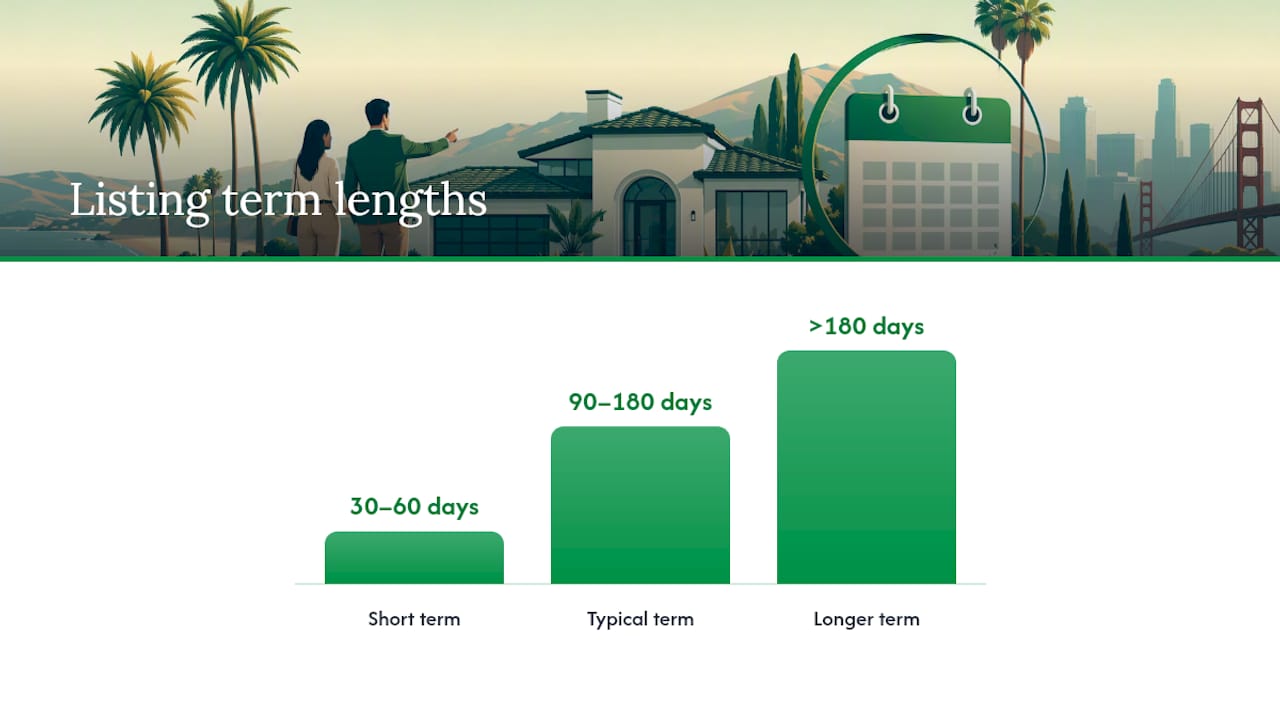
- 90 to 180 days is the typical range for most Santa Cruz County single-family homes and condos, giving enough runway for marketing to work without locking you in indefinitely.
- Shorter terms (30 to 60 days) can make sense in a fast-moving seller's market or if you want to test an agent relationship before committing longer.
- Longer terms (over 180 days) sometimes fit unusual properties, luxury estates, or land parcels that naturally take longer to find the right buyer.
There's no universally correct number. The right term balances giving your agent enough time to execute a real marketing plan against your own flexibility if the relationship isn't working.
Commission, fees, and negotiating compensation
Real estate commissions in California are not set by law, by MLS rule, or by any industry body. They're negotiated between you and your broker on every single transaction. Anyone who tells you a rate is "standard" or "non-negotiable" is stating a norm, not a legal requirement, and it's entirely fair to push back on that framing.
Compensation typically takes one of two shapes. A percentage of the final sale price is the most common structure, usually split between the listing broker and the buyer's broker as an incentive for cooperation. A flat fee arrangement is less common for full-service listings but shows up more often with limited-service or discount brokerages. Either way, the agreement should spell out the total figure and exactly how it divides.
Lack of clarity here is one of the most frequent sources of seller frustration after closing. You should walk into your listing appointment ready to ask:
- What percentage goes to my agent's brokerage versus the buyer's agent's brokerage?
- What specific marketing services are included in this fee, and what's the itemized budget?
- Is there room to adjust the rate if you also represent me as a buyer on my next purchase?
- What happens to marketing costs already spent if I cancel before the home sells?
Pro Tip: Request the compensation clause in writing with a specific dollar range calculated against your expected sale price, not just a percentage. "5%" reads differently once you see it as $50,000 on a $1 million Santa Cruz property.
Third-party industry sources back up the basic mechanics here: brokerage services generally earn compensation only upon a successful closing, which is exactly why the compensation clause and the cancellation terms in your agreement need to work together, not against each other.
How to cancel a listing agreement in California
Listing agreements aren't permanent commitments, but ending one correctly protects both you and your broker from disputes down the line. California relies primarily on the C.A.R. Cancellation of Listing form, known as Form COL, when both parties agree to terminate early.
Here's the practical process:
- Request cancellation in writing. Contact your broker directly and explain why you want to end the listing. Most cancellations happen by mutual agreement rather than dispute.
- Complete Form COL. This document identifies the original listing agreement, states the effective cancellation date, and addresses any reimbursement or protection-period terms both parties accept.
- Confirm signature authority. The form needs to be signed by the broker or an authorized representative, not just the individual agent you worked with.
- Address marketing reimbursement. If the broker already spent money on photography, staging, or advertising, expect a conversation about reimbursement. Ask for itemized receipts and insist any repayment be limited to documented out-of-pocket costs rather than a vague flat fee.
- Get a protected-buyer list. Ask the broker to provide a written list of prospective buyers they introduced to the property during the listing period.
Sometimes cancellation isn't mutual. If you believe the broker breached the agreement, failed to market the property as promised, or acted negligently, you have grounds to push for release without penalty. Document every communication, missed commitment, and marketing failure before escalating. If the broker resists, a real estate attorney can review your specific agreement language and advise on next steps.
The broker protection period, sometimes called a safety clause, deserves close attention. This clause entitles the original broker to commission if you sell to a buyer that broker introduced, even after cancellation, typically for 30 to 90 days following termination. It exists to prevent sellers from cancelling right before closing with a buyer the original agent found, just to avoid paying commission. It's a reasonable protection for brokers, but you should know exactly which names appear on that protected list before you sign with a new agent.
Document everything as you go:
- Keep copies of the signed original listing agreement and the executed COL
- Save proof of delivery for any written cancellation notice
- Retain itemized invoices for any marketing costs the broker asks you to reimburse
- Confirm in writing the exact end date of any broker protection period
Careful documentation here isn't bureaucratic overkill. It's what keeps a routine cancellation from turning into a commission dispute six months later.
Where to find official C.A.R. listing forms
The California Association of REALTORS® maintains the standard forms that brokers across the state use for residential listings. Knowing which form does what saves you from confusion at the signing table.
- RLA (Residential Listing Agreement). The Exclusive Right to Sell form, and the one most sellers will encounter.
- RLAA (Residential Listing Agreement, Agency). The Exclusive Agency version, which carves out an exception if you find your own buyer.
- RLSR (Residential Listing Agreement, Seller Reserved). A less common variant with specific seller-reserved terms; ask your agent to walk through any reserved clauses line by line.
- COL (Cancellation of Listing). The standard form for mutually ending a listing agreement early.
You can view the full library of C.A.R. listing agreements directly through the association, and a sample RLA form is available as a reference PDF if you want to see the actual field layout before your listing appointment.
When reading any of these forms, focus first on the compensation section, the MLS authorization language, the expiration date field, and the modification clause near the bottom, which explains how changes to the agreement must be made and signed. Always request and keep a fully executed copy with all signatures, and confirm the broker-of-record's name matches the license number on file with the DRE.
Practical pre-signing checklist from Desantis Realty Group
Before you sign anything, run through this checklist. It's built from patterns we see repeatedly across Santa Cruz County transactions, and it catches the issues that cause the most regret later.
- Confirm every contract field is filled in accurately, including your legal name, the property's legal description, the exact price, and both start and end dates.
- Verify the broker's identity and license number against the DRE license lookup rather than taking a business card at face value.
- Request an itemized marketing plan in writing, not a verbal promise, covering photography, staging, digital advertising, and open house schedules.
- Confirm the cancellation and protection-period terms before you sign, not after you're already unhappy with the arrangement.
- Get compensation spelled out in dollar terms, not just a percentage, so there are no surprises at closing.
Ask your agent directly: "Can you put that marketing commitment in writing, with an estimated budget?" A confident, prepared agent will answer without hesitation. If you're still weighing whether to work with an agent at all versus selling on your own, that decision should happen before you evaluate any specific listing agreement.
Pro Tip: If an agent pushes back on writing down marketing commitments or dodges questions about compensation splits, treat that as a red flag. Reputable California brokers put this information in writing without hesitation.
Watch for these warning signs, and know what to do if you see them:
- Vague or missing expiration date: Don't sign until it's corrected. This is a compliance issue, not a minor oversight.
- No written marketing plan: Request one before signing, or ask for a shorter initial term while you evaluate performance.
- Pressure to sign a net listing: Ask for a standard Exclusive Right to Sell instead and get a second opinion if the agent resists.
- Unclear protection-period terms after cancellation: Get the specific date range and protected-buyer list in writing before terminating.
Why we typically recommend Exclusive Right to Sell
Sellers sometimes assume Exclusive Right to Sell favors the agent more than them. Having reviewed how these arrangements play out across hundreds of Santa Cruz County transactions, the opposite tends to be true. When an agent knows they'll be compensated regardless of who technically finds the buyer, they invest real money upfront: professional photography, staging consultations, targeted digital campaigns. That spending is what actually moves a listing from sitting on the market to generating competing offers.
Desantis Realty Group has closed more than $200 million in transactions since 2020, and the pattern holds consistently: sellers who understand their compensation structure and marketing commitments upfront negotiate more confidently and end up more satisfied with the outcome, regardless of final sale price. We document marketing spend in writing before a listing goes live, and we build compensation clauses with dollar figures next to the percentages, not instead of them. That transparency is what should be your baseline expectation, whichever brokerage you choose.
— Team
Get your listing agreement reviewed before you sign
Desantis Realty Group offers a free listing agreement review for Santa Cruz County sellers, whether you're evaluating your first agreement or comparing terms from multiple brokerages. Unlike a generic online contract template, we walk through your specific compensation clause, expiration date, and marketing commitments line by line, so nothing catches you off guard at closing.

Our services cover the full arc of a listing: contract review before you sign, negotiation on your behalf once offers come in, a documented marketing plan with an itemized budget, and full MLS exposure the moment your home is ready to list. If you want to see how we approach current listings before committing to anything, browse our seller's guide for a full breakdown of what to expect at each stage. Ready to talk specifics? Reach out for a free contract review, and we'll walk through your listing agreement together before you sign a single page.
Authoritative links and official forms
The forms and statutes below are the primary sources every California seller should consult directly, not just take secondhand.
- California Business and Professions Code §10018.14: the statutory definition of a listing agreement, straight from California law
- C.A.R. listing agreements page: official access point for RLA, RLAA, and related standard forms
- Sample RLA form (PDF): shows the actual field layout for compensation and MLS terms
- DRE reference guide on listing disclosures: explains expiration date requirements and disciplinary risk
- Form COL cancellation guidance: step-by-step instructions for ending a listing agreement properly
This article is general information, not a substitute for advice from a qualified lawyer. Consult a qualified legal professional about your own circumstances before acting on anything here.
Sources
- California Business and Professions Code §10018.14
- Listing agreements — California Association of REALTORS®
- How to fill out the California Cancellation of Listing Agreement (C.A.R. Form COL) — LegalClarity
- Basic contract provisions and disclosures in a residential listing — DRE reference