

Collect three to five quotes from carriers or brokers licensed in your ZIP code, using the California Department of Insurance Home Insurance Finder or an independent broker who works with wildfire-exposed properties. Compare identical dwelling limits, not just price. Treat the California FAIR Plan as your last resort for fire-only coverage, not your first stop. Your rate will hinge mostly on your ZIP code’s wildfire exposure, your home's true rebuild cost, and your claims history.
TL;DR:
- Insurance quotes for wildfire-exposed homes vary significantly by ZIP code, with higher premiums in high-risk fire zones and for older or claims-history homes.
- Standard policies cover the structure, personal property, loss of use, and liability, but do not include earthquake or flood damage, which require separate policies.
- Premium costs depend mainly on wildfire risk, rebuild cost, and claims history, with raising deductibles offering a meaningful way to lower annual expenses.
- Getting accurate quotes early in escrow and documenting mitigation efforts can prevent delays and reduce costs during the home buying process.
- The California FAIR Plan offers fire-only coverage as a last resort, but private insurers typically return to high-risk zones as mitigation and risk models evolve.
Table of Contents
- Where to search for homeowners insurance in California
- How do insurer types compare across California?
- What does a standard California homeowners policy cover?
- What does homeowners insurance not cover in California?
- How much does homeowners insurance cost in California?
- Comparing quotes: the exact checklist to use
- What if no private insurer will cover your home?
- Coordinating insurance during a home purchase
- How do California insurance claims actually work?
- A local view on insuring your Santa Cruz County home
- How Desantis Realty Group keeps insurance from derailing your purchase
- Sources
Where to search for homeowners insurance in California
Start with the state's own tool. The California Department of Insurance Home Insurance Finder lets you search by ZIP code and returns licensed insurers and agents in your area, including a filter for companies still writing new policies in higher fire-risk zones. That filter alone can save you hours, since plenty of carriers quietly stopped accepting new business in the wildland urban interface years ago.
A calculator like MoneyGeek's California cost tool gives you a ballpark before you talk to anyone. It won't reflect your actual roof age or claims history, so treat it as a sanity check rather than a real number.
Here's how to decide who to call first:
- Independent broker: best if you're in a high-fire-risk zone, own an older home, or suspect you'll need the FAIR Plan plus a supplement.
- Captive agent (someone who sells for one company, like State Farm or Farmers): fine for straightforward homes in lower-risk areas with a clean claims record.
- Direct online purchase: works for newer construction in low-risk ZIP codes where underwriting is simple.
Before requesting quotes, have your ZIP code, year built, construction type (wood frame vs. stucco vs. fire-resistant materials), prior claims for the past five years, and your target dwelling limit ready. Agents move faster, and quote you more accurately, when you walk in with that information already organized.
How do insurer types compare across California?
Not every carrier plays the same role. National direct writers, regional carriers, and surplus-line specialty insurers each carry a different risk appetite, and knowing which lane fits your property saves you from wasting time on applications that get declined.
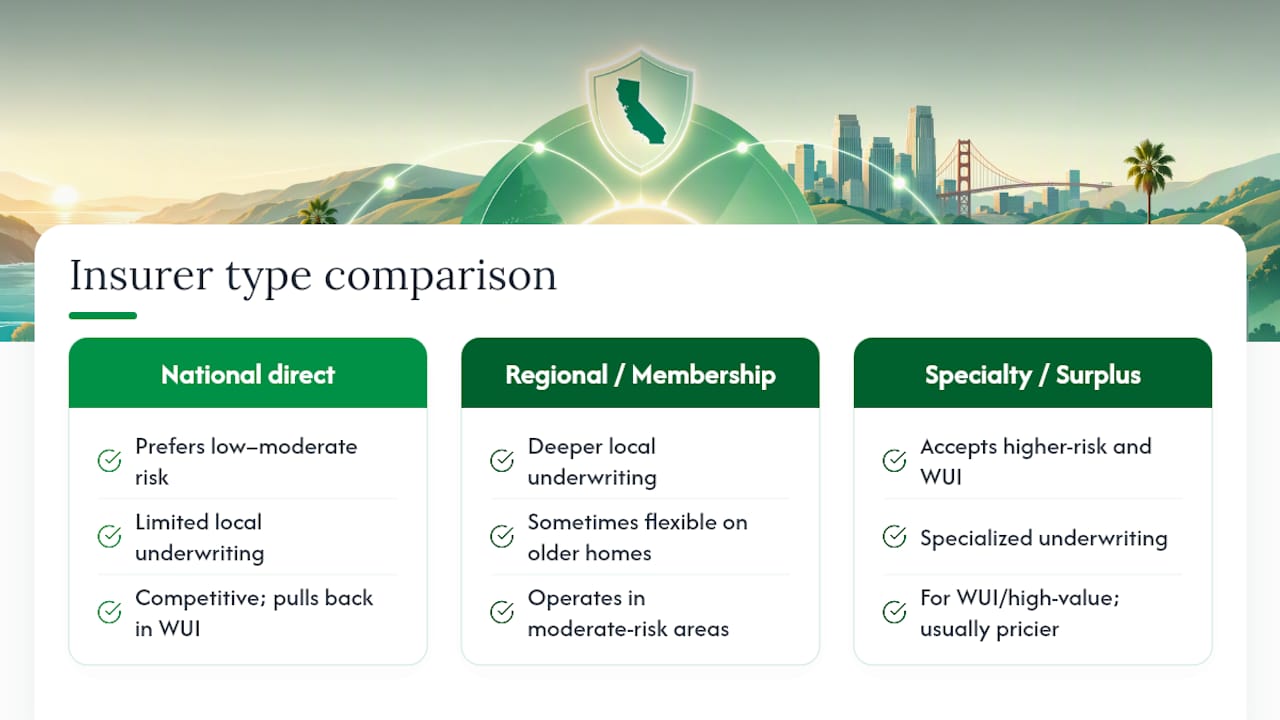
National direct writers such as Travelers, Allstate, Liberty Mutual, and American Family tend to offer competitive pricing in low-to-moderate risk areas but pull back sharply once a property sits inside a designated high-fire-hazard zone. Regional and membership-based insurers, including AAA, CSAA Insurance, Mercury Insurance, and USAA (limited to military-affiliated households), often have deeper local underwriting knowledge and sometimes more flexibility on older homes. Specialty and surplus-line carriers like Bamboo Insurance and high-value insurers such as Chubb frequently step in where standard carriers won't, particularly for wildfire-exposed or higher-value homes, though usually at a premium.
If you own a home in the wildland urban interface, expect to work harder for a quote and possibly pay more for it. Farmers Insurance and similar mainstream writers still operate in many moderate-risk areas, but the WUI is increasingly specialty-carrier territory.
What does a standard California homeowners policy cover?
A standard policy breaks into four core pieces, and understanding them is the difference between a real comparison and guessing based on the sticker price.
- Coverage A (dwelling): rebuilds your home's physical structure after fire, wind, or other covered perils.
- Coverage B (other structures): detached garages, fences, sheds.
- Coverage C (personal property): furniture, electronics, clothing, typically 50 to 70 percent of your dwelling limit.
- Coverage D (loss of use): hotel and living expenses if your home is uninhabitable during repairs.
- Liability (Coverage E) and medical payments (Coverage F): protect you if someone is injured on your property or you're sued for damage you caused elsewhere.
The critical distinction most homeowners miss is replacement cost versus actual cash value. Replacement cost pays what it actually costs to rebuild with today's labor and materials. Actual cash value subtracts depreciation, which in California, where construction labor and lumber costs have climbed sharply since 2020, can leave you thousands of dollars short.
Don't rely on your home's market value or purchase price to set your dwelling limit. Use a professional rebuild estimator based on current local labor and material costs. A Los Angeles luxury construction cost report from Blackbriar illustrates just how far rebuild costs can run in high-cost markets, and similar dynamics apply anywhere coastal or hillside construction gets complicated.
What does homeowners insurance not cover in California?
Standard policies leave real gaps, and closing them requires separate products, not just a bigger limit on your existing policy.
- Earthquake damage is excluded entirely. The California Earthquake Authority sells separate earthquake policies, usually through your existing carrier.
- Flood damage is excluded from every standard homeowners policy. The National Flood Insurance Program through FEMA is the primary source for flood coverage, and it matters more than most inland Californians assume, given how many properties sit near creeks or in low-lying areas.
- Mold and gradual wear-and-tear are almost never covered, regardless of carrier.
- If you're on the FAIR Plan, remember it only covers fire, so you'll need a Difference-in-Conditions (DIC) policy for liability and other perils.
Worth adding if you can: water backup coverage, ordinance and law coverage (covers the gap between your old code-compliant home and current building codes after a rebuild), and wildfire defense endorsements that some carriers now offer for defensible-space work.
Pro Tip: Wildfire mitigation like a Class A fire-rated roof or documented defensible space often qualifies for a discount, but it's rarely applied automatically. Ask your agent directly and bring photos or a contractor's invoice as proof.
How much does homeowners insurance cost in California?
The statewide average lands around $1,543 a year, or about $129 a month, for $250,000 in dwelling coverage, according to MoneyGeek's analysis of nearly 31 million California quotes. That's a starting reference point, not what you'll pay. City-level rates vary enormously depending on fire risk, and coastal towns often price differently than inland valleys with similar home values.
Four factors move your premium more than anything else:
- ZIP-code risk: wildfire and flood exposure drive the biggest swings between neighboring towns.
- Dwelling limit: a higher rebuild cost means a higher premium, full stop.
- Home age and claims history: older homes and any prior claims push rates up.
- Deductible level: raising your deductible from $1,000 to $2,500 can meaningfully lower your annual premium.
NerdWallet's research found premium spreads of several thousand dollars between the cheapest and most expensive carrier quoting the exact same coverage on the same home. That spread is the single best argument for shopping multiple carriers instead of renewing on autopilot. Bundling home and auto, retrofitting an older roof, and asking about mitigation credits are the most reliable ways to trim your bill without cutting coverage.
Comparing quotes: the exact checklist to use
Two quotes that look close on price can differ wildly in what they actually pay out. Run every quote through the same checklist before deciding.
- Confirm the dwelling limit and whether it's based on replacement cost or actual cash value.
- Check the personal property basis (replacement cost versus depreciated value).
- Compare deductible language, including any separate wildfire or wind/hail deductible.
- List every endorsement included or missing (water backup, ordinance and law, wildfire defense).
- Ask how the carrier handles the claims settlement process and average payout timelines.
- Request the carrier's non-renewal history in your area over the past three years.
When you're on the phone with an agent or broker, ask these six questions directly:
- Does this carrier currently write new policies in my fire-hazard zone?
- What mitigation credits do you offer, and what documentation do you need?
- How likely is non-renewal after a single claim?
- Is the dwelling limit based on a professional rebuild estimate or a market-value formula?
- What's excluded that I'd assume was covered?
- What's your average claims processing time for fire versus water damage?
Track answers in a simple spreadsheet with columns for carrier, dwelling limit, deductible, endorsements, and annual premium. It takes ten minutes and makes the comparison obvious instead of a blur of PDFs.
What if no private insurer will cover your home?
When every carrier you approach declines to write your home, usually because it sits in a high-severity fire zone, the California FAIR Plan becomes your fallback. It's a fire-only policy, funded by participating insurers, designed as coverage of last resort rather than a long-term solution.
You apply through a licensed broker or agent, not directly. Limits are typically capped, and since the FAIR Plan only covers fire, you need a companion Difference-in-Conditions policy to fill in liability, theft, water damage, and everything else a standard homeowners policy would normally include.
A few practical moves before you accept FAIR Plan coverage:
- Ask a broker to try at least two more standard-market carriers first. Underwriting appetite genuinely varies company to company.
- Complete visible mitigation work, defensible space clearing, ember-resistant vents, a Class A roof, and document it before reapplying.
- Revisit the private market annually. Insurers do return to areas as wildfire risk-scoring models and mitigation credits evolve.
Coordinating insurance during a home purchase
Run your insurance check the moment you go into contract, not the week before closing. Ask your broker for a preliminary quote based on the property's construction type and fire zone before your contingency period ends, and if insurability looks shaky, make your offer conditional on securing coverage.
Ask the listing agent about prior claims, roof age, and any mitigation work already completed. That information changes your quote significantly and it's worth confirming in writing.
During Santa Cruz County transactions, we help clients run insurance checks early enough that a coverage problem never becomes a closing-day surprise. Understanding how escrow works in Capitola gives you a clear sense of exactly when in that timeline insurance needs to be locked down.
How do California insurance claims actually work?
Filing a claim starts with a call or app submission to your carrier, followed by an adjuster inspection, usually within a few days for standard perils like water damage or wind, but often longer after a widespread wildfire event when adjusters are stretched across thousands of claims at once.
For water damage or theft, expect an adjuster visit within about a week and a settlement offer within two to four weeks if the damage is straightforward and documented. Fire claims move slower because they require a full loss assessment, contractor bids, and often a public adjuster negotiation if the payout looks low relative to actual rebuild costs.
Keep your own documentation independent of the insurer: photos of the property before and after, contractor estimates, and a written timeline of every call and email. The California Department of Insurance accepts consumer complaints if a carrier delays unreasonably or lowballs a settlement, and that complaint history becomes public data other shoppers can check before choosing that carrier. Non-renewal after a single claim is a real risk in fire-prone areas, so ask your carrier directly, before you file, how a claim might affect your renewal.

A local view on insuring your Santa Cruz County home
Coastal homes here often carry lower fire risk but higher rebuild costs due to construction complexity near the water. Inland and hillside properties face the opposite trade-off: cheaper materials, tougher fire underwriting. We've watched buyers get caught off guard during peak summer demand, when quote turnaround slows just as escrow clocks are ticking.
Insurance timing often arises as a key consideration in real estate transactions. Budget for mitigation costs early. It pays off at the underwriting table.
— Team
How Desantis Realty Group keeps insurance from derailing your purchase
A knowledgeable real estate agent can provide valuable assistance navigating underwriting delays and coordinating with insurance brokers during escrow. They can also identify mitigation upgrades that might unlock better rates before closing and help time contingencies to avoid delays causing lost deals.

If you're actively searching for a home in Santa Cruz County, Monterey, or Silicon Valley, start with our buyer's guide or browse current home search listings and reach out before you write an offer. We'll help you build insurance checks into your timeline from day one, not after a problem shows up during escrow.
This article is general information, not a substitute for advice from a qualified financial advisor. Consult a qualified financial professional about your own circumstances before acting on anything here.
Sources
- Home Insurance Finder — California Department of Insurance
- Average cost of home insurance in California (MoneyGeek)
- Flood insurance — FEMA
- Compare insurance premiums — California Department of Insurance