

For most borrowers, the FHA vs conventional decision comes down to one number: your credit score. Borrowers in the mid-600s or below usually save more with FHA's flat mortgage insurance pricing, while those above 700 with a solid down payment typically come out ahead on a conventional loan because they can cancel private mortgage insurance later. Mortgage insurance structure, rather than interest rate differences, is the main factor influencing overall costs over a typical five to ten year homeownership period. The U.S. Department of Housing and Urban Development sets the FHA rules, and refinancing from FHA into conventional once your equity and credit improve is a common, sensible exit.
TL;DR:
- Borrowers with credit scores in the mid-600s typically save money with FHA due to flat mortgage insurance, while those with scores above 700 benefit more from conventional loans because of PMI cancellation options.
- FHA charges a sizable upfront mortgage insurance premium and ongoing MIP that can last the life of the loan unless refinancing occurs after improvements; conventional loans offer credit-priced PMI that is cancellable once equity reaches about 80%.
- Conventional loans require higher minimum credit scores for the best pricing, but they lack upfront insurance costs and allow for second homes and investment properties, which FHA generally does not permit.
- When comparing a mid-600s score with 5 percent down, FHA generally results in lower total monthly costs due to flat MIP pricing, whereas higher-credit borrowers often find conventional loans more cost-effective over a 7-to-10-year period because of PMI cancellation.
- Home condition and local property types significantly influence which loan type is better, with FHA offering clearance on stricter repairs for older homes and conventional loans moving faster on turnkey properties in more modern areas.
Table of Contents
- FHA Loan Benefits: Credit, Down Payment, and MIP Explained
- Conventional Loan Advantages: PMI, Flexibility, and Long-Term Savings
- FHA vs Conventional Loans: A Side-by-Side Comparison
- How Do You Decide Which Loan Is Better?
- When Does Refinancing From FHA to Conventional Make Sense?
- What Santa Cruz County Buyers Should Know
- Let Desantis Realty Group Guide Your Financing Path
- Sources
- FAQ
FHA Loan Benefits: Credit, Down Payment, and MIP Explained
FHA loans exist to widen the door, not narrow it. HUD backs these loans, which lets lenders approve borrowers that conventional pricing models often penalize.
Here's what actually governs eligibility:
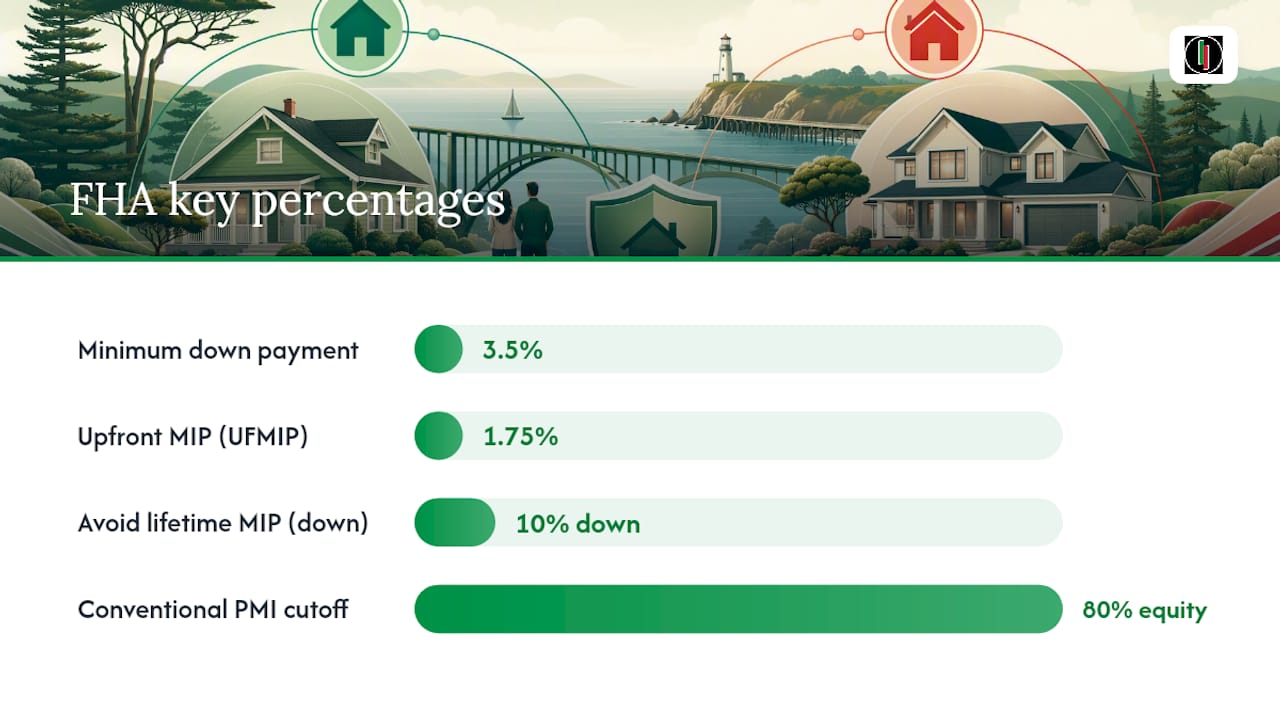
- A credit score of at least 580 typically qualifies for the minimum 3.5% down payment.
- Scores below 580 often require a higher down payment.
- Debt-to-income ratios can run higher than conventional guidelines typically allow, since FHA underwriting has more built-in flexibility for borrowers with steady income but tighter budgets.
- Properties must meet HUD's minimum property standards, and the home must be your primary residence, though 1 to 4 unit properties are allowed.
Pay down a credit card balance 30 days before your lender pulls your report and ask for a rapid rescore.*
The cost of that flexibility is mortgage insurance. FHA charges an upfront mortgage insurance premium (UFMIP) of about 1.75% of the loan amount, which most borrowers finance into the loan rather than pay in cash, plus an annual MIP that gets billed monthly. Put down less than 10%, and that annual MIP generally lasts for the life of the loan. It doesn't disappear at 80% equity the way conventional PMI does.
FHA appraisals also carry a reputation among sellers and listing agents. Appraisers flag issues that conventional appraisals sometimes let slide, like peeling exterior paint, missing handrails, or exposed wiring. That reputation isn't always deserved, but it explains why some sellers hesitate when an FHA offer lands on an older home.
Conventional Loan Advantages: PMI, Flexibility, and Long-Term Savings
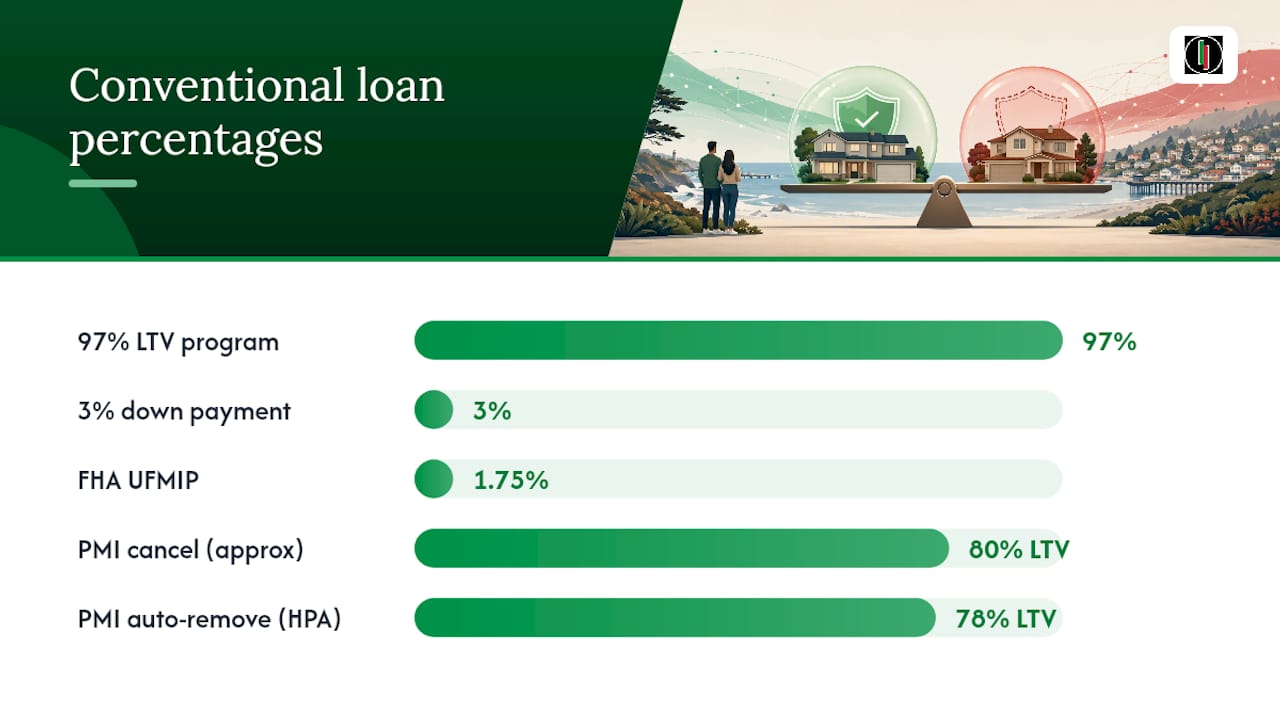
Conventional loans are underwritten to Fannie Mae or Freddie Mac guidelines, and pricing shifts sharply based on your credit tier. Most lenders typically require a minimum credit score around 620, with the best pricing usually available to borrowers with credit scores well above that threshold. First-time buyers with limited savings aren't locked out either. Both Fannie Mae and Freddie Mac offer 97% loan-to-value programs that require just 3% down.
Key mechanics that separate conventional from FHA:
- No upfront mortgage insurance premium, unlike FHA's 1.75% UFMIP.
- Private mortgage insurance (PMI) is priced to your credit score, so a 780 borrower pays far less than a 640 borrower for the same coverage.
- PMI can be requested for cancellation once you reach about 80% loan-to-value, and it must be automatically removed at roughly 78% LTV under the Homeowners Protection Act.
- Second homes and investment properties are eligible, something FHA generally does not allow.
Here's the number that matters most for long-term cost: because PMI is cancellable and credit-priced, a borrower with strong credit and a modest down payment often pays less over a 7 to 10 year hold than an FHA borrower with the same down payment, even though FHA's rate might look slightly better on day one. This is largely a function of loan-level price adjustments, which raise conventional rates and PMI costs specifically for lower-credit borrowers and reward higher scores with cheaper insurance, according to Valley West Mortgage's analysis. Conventional generally fits borrowers with established credit, a larger down payment cushion, and plans to stay in the home long enough for PMI cancellation to pay off.
FHA vs Conventional Loans: A Side-by-Side Comparison
The numbers tell the story better than any explanation can. Here's how the two programs stack up on the factors that actually change your monthly payment and long-term cost.
| Factor | FHA | Conventional |
|---|---|---|
| Minimum credit score | 580 (500 with 10% down) | 620, best pricing above 700 |
| Minimum down payment | 3.5% | 3% (Fannie Mae/Freddie Mac 97% programs) |
| Upfront mortgage insurance | 1.75% UFMIP, usually financed | None |
| Ongoing insurance | Annual MIP, often for the life of the loan under 10% down | PMI, credit-priced, cancellable at 80% LTV |
| Property eligibility | Primary residence, 1 to 4 units | Primary, second home, or investment property |
Example A: Mid-600s score, 5% down. A borrower with a 660 score and 5% down typically sees a lower combined payment on FHA. Conventional loan-level price adjustments push up both the rate and PMI cost at that score tier, while FHA's MIP pricing stays flat regardless of credit, according to Fortune's comparison. FHA usually wins here.
This is the crossover zone lenders talk about, and it typically sits somewhere in the high 600s to low 700s on credit score.
One more wrinkle: 2026 baseline loan limits differ between FHA and conforming conventional loans, with higher ceilings in expensive metro areas. Buyers eyeing homes above the FHA limit in pricier Santa Cruz County neighborhoods. Sometimes you have no choice but conventional, or in the priciest cases, a jumbo loan.
How Do You Decide Which Loan Is Better?
Running the numbers side by side beats guessing every time. Here's the process worth following before you sign anything:
- Pull your actual credit score from all three bureaus. Lenders use the middle score, and it often differs from the free app version you check on your phone.
- Request quotes for both FHA and conventional at your exact score and down payment, not a rounded estimate.
- Make sure the FHA quote includes the financed UFMIP in the total loan amount, not just the base price.
- Ask each lender to model your breakeven if you refinance out of FHA in three years versus staying put for ten.
When you're on the phone with a loan officer, ask directly: How is the UFMIP being financed? Which PMI insurer are you pricing, and does your shop carry any overlays above HUD or Fannie Mae's minimums? What's your average appraisal turnaround right now?
Pro Tip: In Santa Cruz County, older homes near the coast in areas like Pleasure Point or Seabright often have deferred maintenance that trips up FHA's stricter appraisal standards. Get a pre-inspection before you write an offer so repair negotiations don't blow your closing timeline.
If a lender can't answer the overlay question clearly, that's a red flag. Overlays are extra requirements a lender adds on top of FHA or Fannie Mae minimums, and they can quietly disqualify a borrower who would otherwise easily qualify elsewhere.
When Does Refinancing From FHA to Conventional Make Sense?
Model the breakeven honestly before you commit:
- Estimate your current LTV using a recent valuation, not your original purchase price.
- Add up appraisal fees, closing costs, and any lender fees tied to the new loan.
- Divide those total costs by your monthly MIP or PMI savings to get your breakeven in months.
This strategy backfires when home values stall, closing costs run high relative to your loan size, or you're tempted to pull cash out and reset your equity position. A home valuation check before you apply gives you a realistic starting LTV instead of a guess.
What Santa Cruz County Buyers Should Know
Property condition drives more of this decision locally than most buyers expect. Older homes in Boulder Creek, Ben Lomond, and parts of Soquel often run on septic systems and private wells, and FHA's clearer repair standards can actually simplify negotiations when a system needs attention before closing. Conventional appraisals tend to move faster on turnkey properties in Capitola or Aptos, where deferred maintenance is less common.
Loan limits matter more once you're shopping Pleasure Point, Rio Del Mar, or Scotts Valley, where prices frequently push past FHA's local ceiling and enter conventional or jumbo territory. Desantis Realty Group has guided more than 200 clients through $200 million in Santa Cruz County transactions since 2020, and coordinating your lender's timeline with your appraisal and closing schedule is where deals either stay on track or fall apart.
— Mario Desantis
Let Desantis Realty Group Guide Your Financing Path
Choosing between FHA and conventional is only half the equation. The other half is finding a home whose condition, price point, and location match the loan you've settled on, and that's where local guidance pays off. Desantis Realty Group coordinates directly with lenders on rate quotes, manages appraisal scheduling around FHA's property standards, and negotiates repair items with sellers so a low down payment offer doesn't get passed over in a competitive Aptos or Capitola listing.

Buyers weighing financing options for coastal properties should also understand how title insurance protections factor into closing costs, since owner's and lender's policies cover different risks. If a septic inspection or repair item comes up during your FHA appraisal, our guide to preparing a Felton home for appraisal walks through what inspectors typically flag.
Ready to see how your credit score and down payment translate into real listings you can afford in Santa Cruz County? Start with our First Time Home Buyer Guide or reach out directly to get matched with lenders who understand both FHA and conventional pricing at your exact numbers.
This article is general information, not a substitute for advice from a qualified financial advisor. Consult a qualified financial professional about your own circumstances before acting on anything here.
Sources
- HUD: FHA Home Loans
- Conventional vs. FHA home loans: Which is better for you? | Fortune
- FHA vs Conventional Loans in 2026: Which Wins? | Valley West
FAQ
Does FHA cost more than conventional?
It depends on your credit score. Below roughly 680, FHA's flat MIP pricing often beats conventional's credit-tiered PMI, but above that range, conventional usually costs less over time because PMI cancels and FHA's MIP often doesn't.
Why don't sellers like FHA offers?
Some sellers worry about FHA's stricter appraisal standards, which can flag repair items like peeling paint, missing handrails, or exposed wiring that a conventional appraisal might not require fixing before closing.
Is FHA harder to qualify for than conventional?
No, FHA is generally easier to qualify for. It accepts credit scores as low as 500 to 580 and allows higher debt-to-income ratios than most conventional guidelines permit.
Which is better, FHA or conventional?
Neither program is universally better. FHA usually fits borrowers with lower credit scores or limited savings, while conventional usually fits borrowers with stronger credit and a plan to stay in the home long enough to cancel PMI.