

Yes, residential earthquake insurance is available across California, primarily through the California Earthquake Authority (CEA) via participating insurers. It's most valuable for homeowners with high rebuild costs, older or unretrofitted foundations, or properties near active faults. Think of it as catastrophic recovery coverage, not a fix for routine cracks or minor settling.
TL;DR:
- Most California homeowners near active faults or with older, unretrofit foundations should strongly consider earthquake insurance due to higher shaking risks.
- Premiums are impacted by location, home age, foundation type, and chosen deductible, with 15% often the minimum for high-value or older homes.
- Earthquake coverage typically includes dwelling repair, personal property, and temporary living expenses, but excludes land movement, pools, and external damages.
- Only about 10% of homeowners carry earthquake insurance, often due to misconceptions or underestimating total loss costs.
- Buying should happen proactively through existing insurers, with retrofitting offering a cost-effective way to lower both risk and premiums.
Table of Contents
- How Does Earthquake Insurance Work in California?
- What Does Earthquake Insurance Cover, and What Doesn't It?
- How Much Does Earthquake Insurance Cost in California?
- Who Should Actually Buy Earthquake Insurance?
- How Do You Buy Earthquake Insurance, and When?
- Can Retrofitting Lower Your Earthquake Insurance Premium?
- What Do Buyers and Sellers Need to Know About Earthquake Insurance in a Sale?
- Is Earthquake Insurance Worth It for Most California Homeowners?
- How Desantis Realty Group Helps You Navigate Earthquake Risk in a Transaction
- Where to Check Official Earthquake Insurance Rules and Rates
- Sources
How Does Earthquake Insurance Work in California?
The CEA operates as a not-for-profit, public-private mechanism built specifically to keep California's earthquake market solvent after a major event. You cannot buy a CEA policy directly. You buy it as an add-on through the same insurer that writes your homeowners, renters, or condo policy, since CEA distributes exclusively through participating residential insurers.
That structure creates a real prerequisite: you need an existing residential property policy before an earthquake policy can attach to it. California law also requires your insurer to offer earthquake coverage in writing at least every other year, so if you've never seen the offer, ask.
Coverage comes in a few shapes:
- Bundled CEA policies sold alongside your standard homeowners policy through the same carrier.
- CEA Choice, a lower-cost option with reduced personal property and additional living expense limits for homeowners who want cheaper premiums.
- Monoline policies from a handful of private insurers operating outside the CEA system, though these are far less common in the California market.
What Does Earthquake Insurance Cover, and What Doesn't It?
A standard homeowners, renters, or condo policy in California excludes earthquake damage almost entirely, with one narrow exception: fire that starts because of an earthquake. That gap is exactly what earthquake insurance is designed to close, according to the California Department of Insurance's consumer guide.
Only about 10% of California homeowners carry earthquake insurance, according to FEMA, even though the state sits on some of the most active fault systems in the country. Most people either assume their homeowners policy already covers it or underestimate what a total loss would actually cost them.
A typical policy breaks into three parts:
- Dwelling (Coverage A): rebuilds or repairs the structure itself, usually matched to your existing homeowners dwelling limit.
- Personal property (Coverage C): covers belongings damaged in the shaking, often with lower sublimits than dwelling coverage.
- Additional living expenses (Coverage D): pays for temporary housing and related costs if the home is uninhabitable during repairs.
Common exclusions trip people up more than the coverage itself. Land movement, swimming pools, fences, landscaping, and vehicles are typically excluded, along with flood or tsunami damage that comes from outside the structure rather than the shaking itself. Condo owners should pay close attention to HOA master policy assessments. If the association's coverage falls short after a quake and levies a special assessment on unit owners, a personal earthquake policy with assessment coverage can be the only thing standing between you and a five-figure surprise bill.
How Much Does Earthquake Insurance Cost in California?
Deductibles on CEA policies work differently than most insurance you're used to. Instead of a flat dollar figure, the deductible is a percentage of your dwelling coverage limit, and it applies before any payout begins.
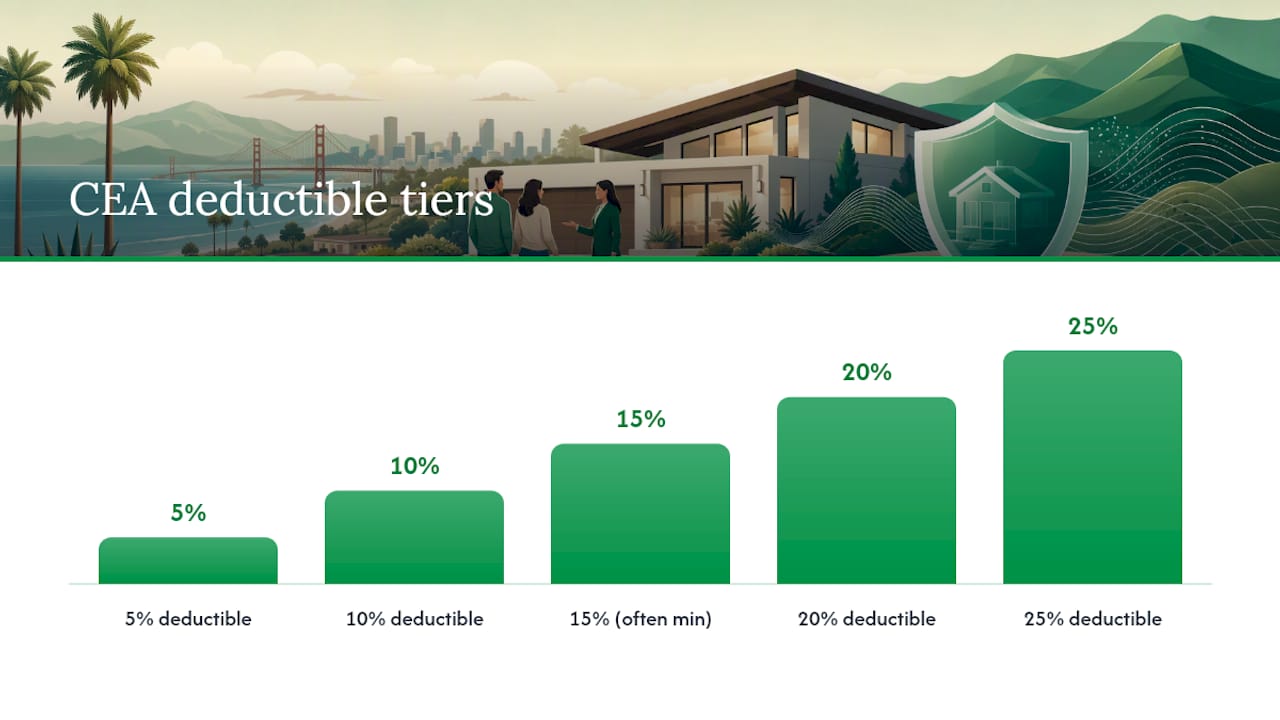
CEA offers deductible tiers of 5%, 10%, 15%, 20%, and 25%, with one important exception: high-value homes and older houses with raised foundations are often required to carry at least a 15% deductible. On a home insured for a typical rebuild cost, a 15% deductible means the first substantial portion of damage comes out of your pocket before coverage kicks in. That math surprises a lot of first-time buyers.
Premiums vary based on several factors working together:
- Distance from active faults and local soil or liquefaction risk
- Rebuild cost and the year your home was built
- Foundation type, particularly whether it's bolted or has a raised cripple wall
- The deductible and coverage limits you select
Because these variables interact in ways that are hard to estimate by hand, your best move is running your own numbers through the CEA premium calculator, which generates a personalized estimate based on your address and home details rather than a statewide average that means little for your specific property.
Pro Tip: *Run the CEA calculator with two deductible tiers side by side.
Who Should Actually Buy Earthquake Insurance?
Not every California homeowner needs this coverage, but a few risk factors make it worth serious consideration. Run through this checklist before deciding either way:
- Fault proximity. Homes near mapped active faults face materially higher shaking intensity in a major event, a factor USGS treats as a primary input in risk assessment.
- Soil and liquefaction risk. Certain soil types amplify shaking or liquefy entirely, which can cause severe foundation damage even in moderate quakes.
- Home age and foundation type. Houses built before modern seismic codes, especially those with raised, unbolted foundations, carry disproportionate risk.
- Replacement cost exposure. The higher your rebuild cost, the larger the dollar gap a total loss would create without coverage.
- Mortgage and financial cushion. If you couldn't absorb a six-figure rebuild cost out of pocket, insurance closes that exposure.
- Retrofit status. Homes already retrofitted carry lower risk and sometimes qualify for better rates.
Renters should know their landlord's policy won't cover personal belongings, and separate renters earthquake coverage exists for that gap. Condo owners need to check what their HOA policy actually covers versus what falls to individual unit owners. FEMA is explicit that federal disaster assistance is limited and was never designed to fully rebuild a home, which is precisely the gap private insurance is built to fill.
How Do You Buy Earthquake Insurance, and When?
Buying earthquake insurance starts with your existing residential insurer, not a separate application. California requires that insurer to offer coverage in writing at least once every other year, so the door is always open even if you've passed on it before.
One timing detail catches people off guard: after a significant seismic event, some insurers impose a temporary moratorium on new earthquake policies or endorsements in the affected area. You can't wait until the ground is already shaking to get covered, which is exactly why the decision needs to happen well before an event, not during the anxious aftermath of one.
Practical steps to follow:
- Confirm your current dwelling coverage limit on your homeowners policy, since CEA limits typically tie to that number.
- Request a personalized estimate from the CEA premium calculator.
- Choose your deductible tier and coverage limits based on what you could realistically absorb out of pocket.
- Confirm your insurer participates in the CEA program, since not every carrier does.
Can Retrofitting Lower Your Earthquake Insurance Premium?
Retrofitting is often the single most cost-effective lever homeowners have over both risk and premium. Older homes with raised foundations, unbolted sill plates, or unbraced cripple walls face the highest seismic vulnerability, and those are exactly the homes retrofitting helps most.
Common retrofit measures include:
- Bolting the house frame to its foundation
- Bracing cripple walls to prevent collapse during lateral shaking
- Strapping or anchoring water heaters to prevent gas line ruptures
Verified retrofits can lead to real discounts through CEA and participating insurers, and in some cases affect which deductible tiers you qualify for. The catch is documentation. Insurers want proof, not just your word, so get a professional inspection and keep the paperwork. If a contractor flags cracking or settling during that inspection, a resource like Foundation Cracks: When to Worry and What to Do walks through which issues warrant professional repair before you present anything to an insurer.
Pro Tip: Keep retrofit permits, contractor invoices, and before-and-after photos in one file. When it's time to renew or shop your policy, that documentation moves the conversation from "trust me" to "here's the proof," which speeds up any discount review.
What Do Buyers and Sellers Need to Know About Earthquake Insurance in a Sale?
A home's earthquake insurance history and retrofit records shape buyer confidence more than most sellers expect. A documented retrofit with permits and inspection reports can be a genuine negotiating asset, signaling lower risk and often smoother insurability for the next owner. The absence of any record, on the other hand, tends to invite more questions and sometimes a lower initial offer.
Buyers and their agents should request:
- Current policy limits and deductible tier, if a policy exists
- Proof of any retrofit work, including permits and contractor documentation
- A recent replacement-cost estimate for the dwelling
- HOA master policy details and assessment exposure, for condos
These details matter most during escrow, where surprises cost the most time. Our own breakdown of how escrow works when buying in Capitola covers where insurance and disclosure items typically surface in that timeline.
Is Earthquake Insurance Worth It for Most California Homeowners?
The homeowners who benefit most from earthquake insurance aren't a mystery: high rebuild cost, an older or unretrofitted foundation, or a location close to an active fault. If none of those apply strongly to you, the calculus shifts, and a smaller emergency fund might do the job that a policy would otherwise cover.
Our honest read is that too many California homeowners treat this decision emotionally instead of running the numbers. Start with the CEA calculator before making any decision. If your exposure looks high, get a retrofit estimate next, since that single step can lower both your risk and your premium at once. This coverage exists for catastrophic loss, not routine repairs, so budget for it accordingly rather than expecting it to behave like a general home warranty.
— Team
How Desantis Realty Group Helps You Navigate Earthquake Risk in a Transaction
Get local, transaction-specific guidance on how earthquake exposure can affect real estate sales or purchases. Experience with real estate escrows helps identify when insurance questions and retrofit documentation might arise during transactions.

This can include connecting clients with retrofit and inspection specialists and assisting with insurance disclosures during escrow negotiations. If you're buying, our first-time buyer guide walks through what to ask for before you write an offer. If you're selling and want to know how your home's condition and location affect its market position, start with a free home valuation and we'll talk through the rest from there.
Where to Check Official Earthquake Insurance Rules and Rates
- CEA premium calculator: for a personalized rate estimate based on your address and home details.
- CDI consumer guide (PDF): for deductible rules, coverage parts, and exclusions in plain language.
- USGS hazard data: for fault proximity and regional risk factors behind your decision.
- FEMA earthquake guidance: for understanding the limits of federal disaster aid versus private coverage.
Sources
- Earthquake Insurance (California Department of Insurance consumer guide)
- California Earthquake Authority (CEA)
- Earthquake insurance (FEMA)
- How do I decide whether or not to get earthquake insurance? (USGS)