

A HELOC usually costs less if your equity, credit, and timeline all qualify you for one. A bridge loan wins when you need cash in days rather than weeks, or your equity position is too thin for a lender's comfort. The choice comes down to four variables: how much equity you can actually tap, how fast you need the money, where your credit stands, and how long you expect to carry both properties. The decision framework below walks through each one.
TL;DR:
- A bridge loan offers faster funding within 5 to 10 days, making it ideal for urgent purchase deadlines, but it generally comes with higher rates and fees.
- HELOCs take 14 to 30 days to fund, feature variable interest rates, and are better suited for homeowners with flexible timelines and strong equity positions.
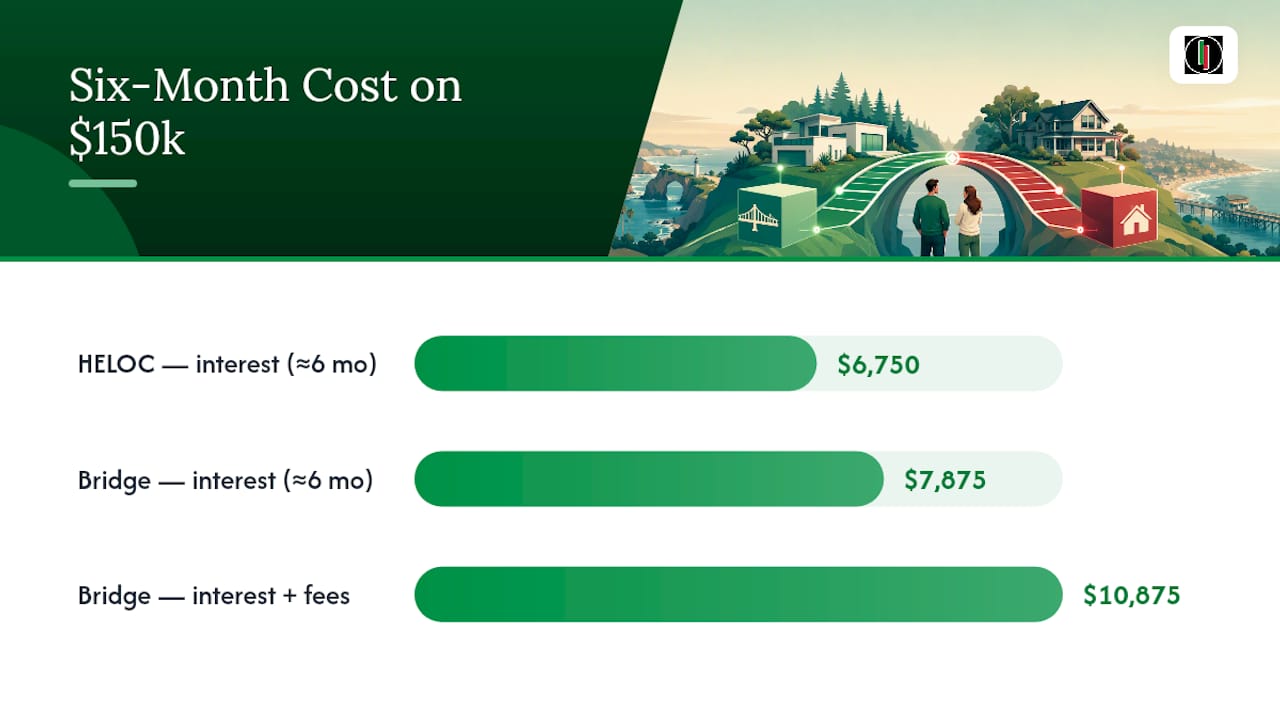
- When comparing costs, a short-term bridge loan can cost roughly $10,875 on a $150,000 amount held for six months, while a HELOC may cost around $6,750 in interest.
- The main factor influencing choice is the timeline: if your move needs funding within two weeks, a bridge loan is more appropriate; if you have about a month, a HELOC often saves money.
- Properly timing your sale through strategic marketing and listing planning can reduce the need for either product, especially in competitive markets like Santa Cruz County.
Table of Contents
- Bridge Loan vs HELOC: What a Bridge Loan Actually Is
- Bridge Loan vs HELOC: How a HELOC Actually Works
- Bridge Loan vs Home Equity Loan and HELOC: Comparing the Trade-Offs
- What Bridge Loans and HELOCs Actually Cost You
- Who Actually Qualifies, and How Fast
- Where Bridge Loans and HELOCs Get Borrowers Into Trouble
- A Three-Step Framework for Choosing Between Bridge Loan and HELOC
- Other Ways to Fund the Gap
- The Local View: Why Speed Often Beats a Lower Rate in Santa Cruz County
- Why Move-Up Buyers Overthink the Rate and Underthink the Timeline
- Let Desantis Realty Group Coordinate Your Sale and Purchase Timeline
- Sources
Bridge Loan vs HELOC: What a Bridge Loan Actually Is
A bridge loan is a short-term, lump-sum loan secured by your current home, built to cover the gap between buying your next place and closing the sale on your old one. Most bridge loans run six to twelve months, and funding moves fast because lenders are underwriting against your existing equity rather than a lengthy income and asset review.
Speed is the entire point. Bridge lenders in California commonly fund within 5 to 10 business days, which matters when you are competing for a home in a tight Santa Cruz County market and cannot make your offer contingent on selling first.
Repayment structures vary by lender, but three patterns show up most often:
- Interest-only payments during the loan term, with the principal due at sale
- A balloon payment covering the full balance once your old home closes
- Deferred payments that accrue and get paid off in one lump sum at closing
Expect an origination fee, appraisal costs, and sometimes an exit fee if you pay off the loan early. Rocket Mortgage's comparison notes that bridge loans generally carry higher rates than a HELOC precisely because they trade cost for speed and flexibility.
Bridge Loan vs HELOC: How a HELOC Actually Works
A HELOC is a revolving line of credit secured by your home, structured in two phases: a draw period where you borrow against the line as needed, and a repayment period where you pay down the balance. The Consumer Financial Protection Bureau describes it as open-end credit, meaning you can draw, repay, and draw again during that first phase, similar to a credit card backed by your house.
Draw periods typically run five to ten years, and the interest rate floats with the prime rate, so your payment can rise or fall over time. That variability is the main trade-off for a lower starting cost.
A few things shape whether a HELOC fits your timeline:
- Funding usually takes 14 to 30 business days once you apply, since lenders run full underwriting
- Your combined loan-to-value ratio (CLTV) determines how much you can borrow
- Credit score and debt-to-income ratio both factor into approval and your rate
If your move-up timeline allows a few weeks of runway, a HELOC gives you access to funds without locking you into a short repayment clock.
Bridge Loan vs Home Equity Loan and HELOC: Comparing the Trade-Offs
Once you line the two products up side by side, the decision usually clarifies fast. Here's how they stack up across the factors that matter most to a move-up buyer:
- Funding speed. Bridge loans close in about 5 to 10 business days; HELOCs take roughly 14 to 30. If your purchase offer needs proof of funds next week, that gap alone can decide the question.
- Rate range. Mid-2025 data put bridge loans around 8.5% to 12%, while HELOCs ran closer to 8.27% to 9.5% over the same period. The spread is real money over even a short hold.
- Fee structure. Bridge loans often carry origination and exit fees layered on top of interest. HELOCs tend toward lower upfront costs, though some lenders charge annual fees or early-closure penalties.
- Collateral and equity draw. Both use your home as collateral, but HELOC lenders typically cap combined borrowing at a stricter CLTV than bridge lenders will accept.
- Repayment risk. A HELOC's variable rate means your payment can climb during the draw or repayment period. A bridge loan's risk is different: if your sale slips past the loan's maturity, you may face pressure to accept a lower offer just to close before the balloon payment hits.
Run the numbers on a $150,000 short-term need held for six months. At 9% on a HELOC, you're looking at roughly $6,750 in interest, plus modest closing costs. At 10.5% on a bridge loan, plus a 2% origination fee, that same $150,000 costs about $7,875 in interest and $3,000 upfront, for a total closer to $10,875. The rate gap alone can add thousands to your total cost even on a short hold, which is why the decision isn't just about who approves you fastest.
The variable that moves the needle most is usually timeline. If you have 30 days of breathing room, cost typically wins. If you have ten days, speed wins regardless of rate.
What Bridge Loans and HELOCs Actually Cost You
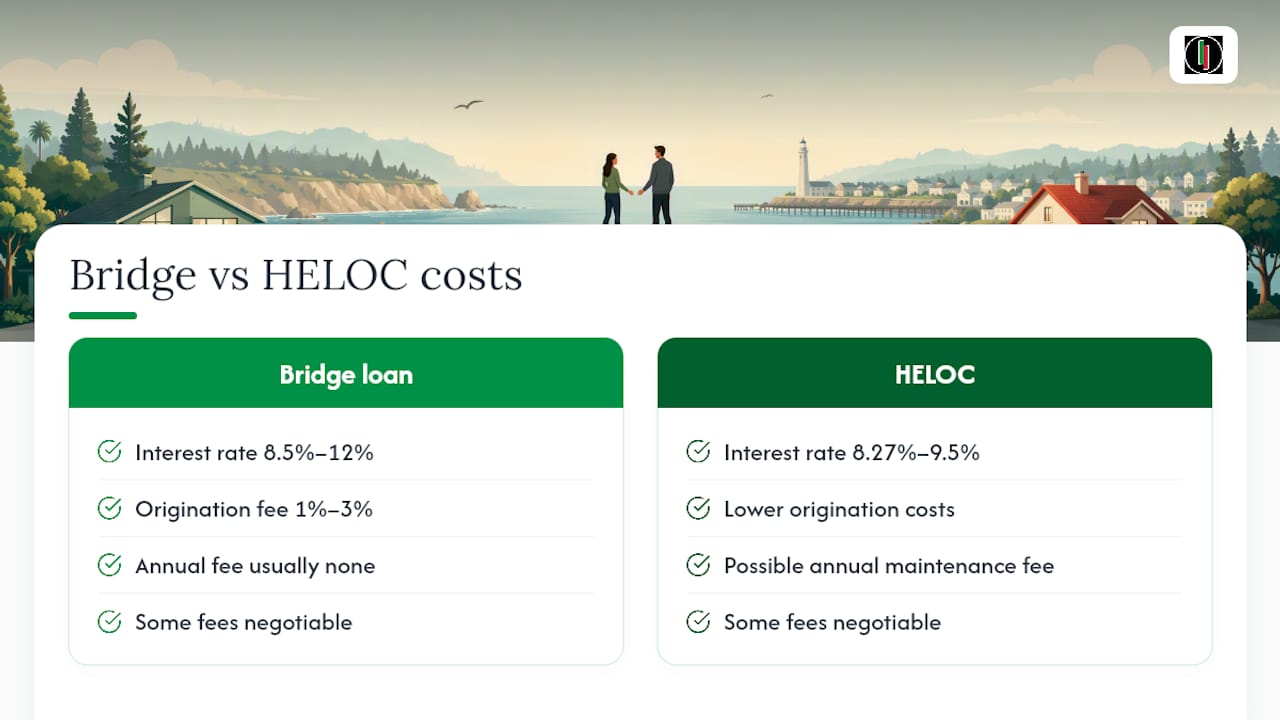
Mid-2025 rate data shows bridge loans running 8.5% to 12%, with origination fees commonly landing between 1% and 3% of the loan amount. HELOCs during the same window priced closer to 8.27% to 9.5%, with lower origination costs but potential annual maintenance fees.
Pro Tip: Ask every lender for their full fee schedule in writing before you compare rates. A HELOC with a slightly higher rate but no annual fee can beat a "cheaper" one loaded with maintenance charges.
Origination fees and appraisal costs are usually fixed. Rate margins and annual fees are sometimes negotiable, especially if you already bank with the lender or carry a strong credit profile. On a $200,000 bridge loan at 10% for eight months with a 2% origination fee, you'd budget roughly $13,333 in interest plus $4,000 upfront, before closing costs. Run your own numbers against current quotes since rates shift regularly.
Who Actually Qualifies, and How Fast
Lenders look at different thresholds depending on the product, and those thresholds decide how fast you can move.
- HELOC lenders generally cap combined loan-to-value at 85% CLTV or lower, meaning you need meaningful equity cushion beyond your existing mortgage.
- Bridge lenders tend to focus more on your home's current equity position and less on a deep income and debt review, which is part of why they close faster.
- Credit score expectations run similar across both, generally in the high 600s to 700s for the best pricing, though bridge lenders sometimes flex on this given the shorter exposure window.
- Debt-to-income ratio matters more for a HELOC's full underwriting than it typically does for a bridge loan.
A HELOC's slower funding comes from full underwriting: income verification, appraisal, and title work. A bridge loan skips much of that in favor of speed, which is the entire trade you're making.
Where Bridge Loans and HELOCs Get Borrowers Into Trouble
The biggest risk with a bridge loan is timeline pressure. If your old home doesn't sell before the loan matures, you may feel forced to drop your price just to close before the balloon payment lands, a dynamic industry analysts flag repeatedly as the product's biggest downside.
HELOC borrowers face a different trap: payment shock. When the draw period ends and repayment begins, your monthly payment can jump sharply, especially if rates climbed during your draw window.
Pro Tip: Before signing either loan, ask specifically about extension options and any prepayment penalties. A bridge loan with no extension clause can turn a short delay into a forced sale.
A Three-Step Framework for Choosing Between Bridge Loan and HELOC
Work through these three steps in order, and the right answer usually becomes obvious by step two.
- Check your equity position. Calculate your current CLTV by dividing your total mortgage balances (plus the new loan) by your home's appraised value. If you're comfortably under 80% to 85%, a HELOC is likely on the table. If you're tighter than that, a bridge loan's more flexible equity requirements may be your only realistic path.
- Audit your timeline against lender funding speed. If you need funds within two weeks, a HELOC's 14 to 30 business day timeline probably won't work. A bridge loan's 5 to 10 day turnaround fits real deadline pressure.
- Model your worst-case cost. Assume your sale takes twice as long as expected, or your HELOC's variable rate climbs a point or two. Which product still leaves you in a manageable position?
As a rough default, a HELOC fits homeowners with strong equity and a flexible closing date. A bridge loan fits homeowners with a firm deadline or limited accessible equity. When you're unsure, preparing your current home for a faster sale shortens your timeline enough that either option becomes workable.
Other Ways to Fund the Gap
Neither product is your only option, and sometimes a different structure fits better.
- Cash-out refinance replaces your existing mortgage with a larger one, pulling equity out in a lump sum. It works well if current rates beat your existing mortgage rate, but it resets your entire loan term.
- Home equity loan gives you a fixed lump sum at a fixed rate, unlike a HELOC's revolving structure. It suits a known, one-time need rather than an open-ended draw.
- Contingent offers or rent-back agreements let you negotiate directly with a seller, sometimes avoiding bridge financing entirely. Skilled negotiation on your agent's part can secure a rent-back period that buys you selling time without a loan at all.
- Combining a smaller HELOC with a short bridge loan sometimes covers a gap neither product handles well alone.
The Local View: Why Speed Often Beats a Lower Rate in Santa Cruz County
In a market where well-priced homes in Felton, Capitola, or Aptos routinely draw multiple offers within days, speed changes the calculus. A homeowner with a signed HELOC still waiting on funding can lose a home to a buyer holding bridge financing that has already closed.
Having helped structure more than $200 million in transactions since 2020, Desantis Realty Group has watched clients weigh this trade-off repeatedly. The pattern holds: when a listing is priced right and staged well, reducing days on market often does more for a client's financial position than saving a point on financing. Coordinating your listing's pre-marketing, staging, and pricing strategy with a knowledgeable local agent, drawing on approaches like those outlined in competitive listing strategy guides, reduces the timeline risk that makes bridge loans necessary in the first place.
Why Move-Up Buyers Overthink the Rate and Underthink the Timeline
Most homeowners walk into this decision asking, "Which loan is cheaper?" That's the wrong first question. The right first question is, "What happens if my sale takes longer than I expect?"
A HELOC's lower rate looks appealing on paper, but if your timeline is tight and you miss a purchase window because funding took three weeks instead of one, the "savings" evaporate. I've watched the inverse happen too: buyers rush into a bridge loan out of anxiety when they actually had 45 days of runway and could have qualified for a HELOC with real savings.
The honest answer is that the loan product matters less than an accurate read of your own timeline. Get that wrong, and either choice can backfire. Get it right, and the decision becomes almost mechanical: equity and patience point toward a HELOC, deadline pressure points toward a bridge loan. Santa Cruz County's competitive listing environment makes that deadline pressure more common than homeowners expect, which is exactly why the equity and timeline audit in this guide comes before any rate comparison, not after.
— Mario Desantis
Let Desantis Realty Group Coordinate Your Sale and Purchase Timeline
Desantis Realty Group's advantage isn't a financing product. It's coordination: pricing and marketing your current home to sell fast enough that you may not need bridge financing at all, while lining up your next purchase so the timing actually works.

Since 2020, Mario Desantis and his team have guided more than 200 clients through exactly this kind of move-up transition across Santa Cruz County, Silicon Valley, and Monterey County, using strategic pricing, negotiation, and local market timing to shrink the gap between selling and buying. If you're weighing a bridge loan against a HELOC right now, the smarter first move might be shortening your timeline enough that the choice gets easier. Start by browsing current home search listings or reach out through the Seller's Guide to map out a coordinated sale-and-purchase plan before you commit to either loan.
Sources
- Consumer Financial Protection Bureau: What is a home equity line of credit (HELOC)?
- CapitalLending / Bankrate bridge loan vs HELOC rate comparison (July 2025)